Organizational Optimization Leadership Course
Lead the Organization. Align the Enterprise. Optimize Performance.
The Organizational Optimization Leadership (OOL) Certification Course is a professional leadership development program designed to equip executives, managers, emerging leaders, and organizational decision-makers with the knowledge, competencies, and practical leadership tools necessary to lead organizational optimization and translate strategic vision into measurable results. Organizational excellence does not occur simply because an organization has talented employees, sufficient resources, sophisticated technology, or a well-developed strategic plan. Sustainable success requires leaders who understand how to align strategy, people, processes, resources, technology, performance, culture, and risk around common organizational objectives.
The Organizational Optimization Leadership course develops leaders who can see beyond their individual departments and responsibilities and understand the organization as an interconnected enterprise system. Participants learn how leadership decisions influence organizational alignment, execution, effectiveness, efficiency, accountability, performance, risk, and ultimately the organization's ability to accomplish its mission and vision. The objective is to develop leaders who do more than manage organizational activity. They learn to lead optimization.
Why Take the Organizational Optimization Leadership Course?
One of the greatest challenges facing organizations is not developing strategy—it is executing strategy consistently throughout the organization. Leadership may establish clear objectives at the executive level, yet those objectives can become diluted or disconnected as they move through business units, departments, teams, processes, and individual responsibilities. The result can be organizational silos, competing priorities, inefficient use of resources, unclear accountability, inconsistent communication, duplicated efforts, ineffective processes, and performance that falls short of leadership expectations. The Organizational Optimization Leadership course helps leaders understand how to recognize and address these conditions. Participants learn how to create stronger connections between: Vision → Strategy → Leadership → People → Resources → Processes → Execution → Performance → Results
Leaders develop the ability to recognize where organizational systems are working together—and where misalignment may be preventing the organization from achieving its full potential.
The Leader's Role in Organizational Optimization
Organizational Optimization requires more than process improvement. It requires leadership.Leaders establish priorities, allocate resources, influence culture, communicate expectations, establish accountability, manage risk, make decisions, remove organizational barriers, and determine what receives attention throughout the enterprise. For this reason, leadership is one of the most important drivers of organizational optimization. The Organizational Optimization Leader learns to ask critical questions:
1) Are our people focused on the organization's most important priorities?
2) Are our resources aligned with our strategy?
3) Are we doing the right work?
4) Are we doing the work right?
5) Do employees understand how their responsibilities contribute to organizational objectives?
6) Are organizational functions collaborating or operating in silos?
7) Are our performance measures telling us what leadership actually needs to know?
8) Are we identifying and managing risks before they affect strategic objectives?
9) Are we continuously improving—or simply maintaining the status quo?
The OOL course gives leaders a framework for answering these questions and acting upon the results.
Result-Focused Leadership
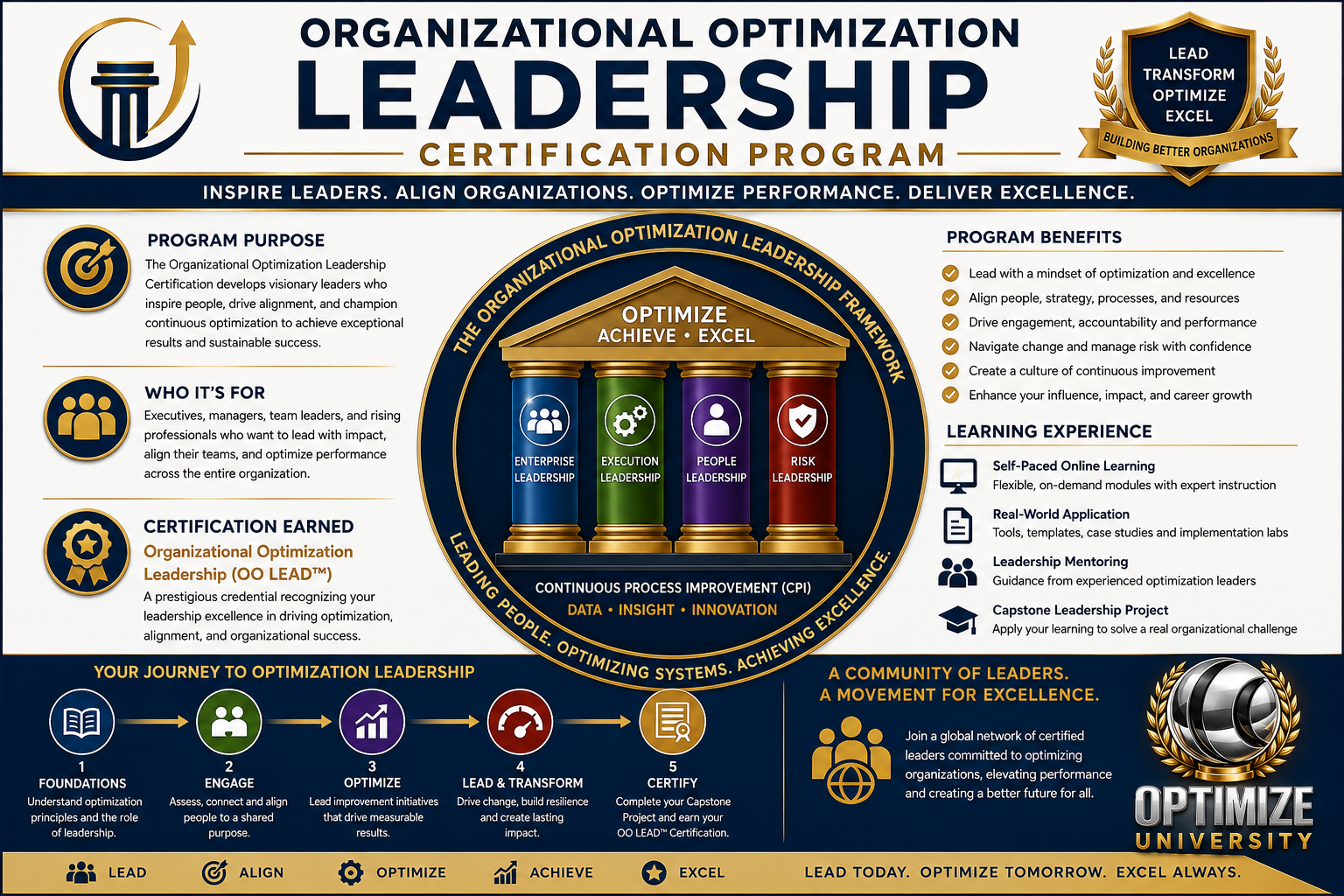
Organizational Optimization Leadership is fundamentally results-focused.Leadership effectiveness should ultimately be reflected in the organization's ability to accomplish its mission, execute its strategy, achieve measurable objectives, and continuously improve performance. Participants learn how to connect leadership actions and decisions with organizational outcomes. The course develops leadership capability across four critical dimensions:
1) Enterprise Leadership - Develop the ability to view the organization beyond individual departments and understand how strategy, structure, people, processes, technology, resources, culture, performance, and risk interact across the enterprise. Leaders learn to consider the broader organizational consequences of decisions and create stronger alignment around enterprise objectives.
2) Execution LeadershipLearn how to translate strategic priorities into clear expectations, accountable actions, measurable objectives, and organizational results.Execution Leadership emphasizes converting leadership intent into coordinated action throughout the organization.
3) People Leadership - Develop the leadership practices necessary to align, engage, develop, empower, and hold people accountable for contributing to organizational objectives. Participants examine how communication, culture, trust, expectations, talent, collaboration, and accountability influence organizational performance.
4) Risk Leadership - Develop an enterprise perspective toward risk and understand leadership's responsibility for identifying, evaluating, communicating, managing, and monitoring risks that could affect organizational objectives. Risk becomes an integrated component of leadership decision-making rather than a separate compliance activity.
What You Will Learn
Throughout the Organizational Optimization Leadership course, participants develop practical leadership capabilities in the areas that most directly influence organizational performance.
* Strategic Alignment - Learn how to connect organizational vision and strategy with priorities, resources, business functions, teams, and individual responsibilities.
* Organizational Alignment - Understand how leadership, strategy, people, resources, processes, communication, and performance systems must work together to achieve common objectives.
* Leadership Communication - Develop stronger communication pathways that translate executive intent and strategic priorities into understandable expectations throughout the organization. Equally important, leaders learn the value of feedback mechanisms that allow information, concerns, opportunities, and performance data to move back through the organization to decision-makers.AccountabilityLearn how to establish clear ownership, expectations, responsibilities, measures, and consequences so organizational priorities translate into action.
* Organizational Effectiveness - Examine whether the organization is focused on the activities that produce the greatest strategic value. Are we doing the right work?
* Organizational Efficiency - Examine how effectively the organization utilizes its people, processes, technology, time, information, and financial resources. Are we doing the work right?
* Resource Optimization - Learn how leaders can better align human capital, technology, financial resources, information, and organizational capabilities with strategic priorities.
* Performance Leadership - Develop the ability to establish meaningful measures, evaluate organizational performance, identify gaps, and use performance information to make better leadership decisions.
* Continuous Process Improvement - Understand how Continuous Process Improvement (CPI) supports Organizational Optimization and how leaders can establish an environment where improvement becomes part of everyday organizational behavior.
* Change and Transformation Leadership - Learn how leaders can communicate the need for change, establish direction, build commitment, remove barriers, and sustain organizational improvement initiatives.
The Organizational Optimization Leadership Approach
Participants learn to lead optimization through a disciplined leadership framework:
1. Understand the VisionClarify where the organization is going and what leadership is attempting to achieve.
2. Understand the StrategyTranslate strategic objectives into organizational priorities and expected outcomes.
3. Assess the Current StateExamine whether organizational capabilities, people, processes, resources, performance, and culture support those objectives.
4. Identify the GapsRecognize where misalignment, resource constraints, ineffective processes, communication failures, organizational silos, or performance deficiencies may prevent successful execution.
5. Establish PrioritiesDetermine which organizational issues require leadership attention and which improvement initiatives will produce the greatest organizational value.
6. Align Resources and AccountabilityEnsure people, funding, technology, processes, responsibilities, and leadership attention support the organization's most important priorities.
7. Lead ExecutionCreate clear expectations, remove barriers, monitor progress, manage risk, and maintain organizational focus.
8. Measure ResultsEvaluate whether leadership actions and optimization initiatives are producing the intended outcomes.
9. Continuously ImproveUse performance information, organizational assessments, employee feedback, lessons learned, and CPI to continually improve organizational capability.
From Managing Activities to Leading Outcomes
Traditional management can become focused on activities: meetings held, reports produced, projects completed, budgets spent, and tasks accomplished. Organizational Optimization Leadership shifts the emphasis toward outcomes. The critical question is not simply:“Did we complete the work? ”It is:“Did the work produce the organizational result we intended?” This distinction helps leaders move beyond managing activity toward managing and optimizing organizational performance.
Who Should Enroll?
The Organizational Optimization Leadership Certification Course is designed for professionals who lead people, programs, functions, resources, or organizational initiatives, including: C-suite executives, senior executives and directors, business unit leaders, department and functional managers, emerging leaders, program and project leaders, operations leaders, human capital and organizational development leaders, strategy professionals, transformation and change leaders, continuous process improvement leaders, government and military leaders, business owners and entrepreneurs, and professionals preparing for greater organizational leadership responsibilities.
Certification Outcomes
Upon successful completion of the Organizational Optimization Leadership course, participants should be better prepared to:
* Lead organizational optimization initiatives within their area of responsibility.
* Translate organizational vision and strategy into actionable priorities.
* Align people, resources, processes, technology, and organizational capabilities with strategic objectives.
* Recognize organizational misalignment and performance gaps.
* Improve communication between leadership, functions, teams, and employees.
* Establish clearer organizational accountability.
* Evaluate organizational effectiveness and efficiency.
* Optimize the utilization of human, technological, financial, and operational resources.
* Use performance measures and organizational information to strengthen leadership decision-making.
* Integrate risk considerations into strategic and operational leadership decisions.
* Sponsor and support Organizational Optimization, Continuous Process Improvement, and transformation initiatives.
* Create an environment in which continuous improvement becomes part of organizational culture.
* Connect leadership decisions with measurable organizational outcomes.
* Organizational BenefitsOrganizations that develop leaders in Organizational Optimization gain managers and executives who are better equipped to understand the enterprise implications of their decisions.
These leaders become better prepared to identify organizational barriers, challenge inefficient practices, align resources with priorities, strengthen accountability, improve cross-functional collaboration, support improvement initiatives, and maintain focus on measurable results. More importantly, Organizational Optimization Leadership can help create a common leadership language and management philosophy across the organization. When leaders at multiple levels understand optimization principles, the organization becomes better positioned to connect: Leadership Intent → Organizational Alignment → Coordinated Execution → Measurable Performance → Continuous Improvement
This strengthens the organization's ability to execute strategy consistently across departments, functions, and levels of leadership.
Leadership's Role in the Optimization Journey
Organizational Optimization is not a project with a beginning and an end. It is an ongoing leadership responsibility. Organizations, markets, technologies, risks, customer expectations, workforce capabilities, and competitive environments continually change. An organization that is optimized today cannot assume it will remain optimized tomorrow. Leaders must therefore continually assess organizational performance, challenge assumptions, identify emerging gaps, align resources, develop people, manage risks, improve processes, and adapt organizational capabilities. The Organizational Optimization Leader helps create the environment where this continuous journey becomes possible.
From Leadership Vision to Organizational Results
Great organizations require more than great strategies. They require leaders capable of transforming those strategies into coordinated organizational action. The Organizational Optimization Leadership Certification Course develops leaders who understand how to connect vision with strategy, strategy with people, people with execution, execution with performance, and performance with continuous improvement. The result is a leader better equipped not simply to manage within the organization—but to help optimize the organization itself.
This positioning also helps create a logical Optimize University pathway:
Organizational Optimization Awareness establishes the foundational understanding; Organizational Optimization Leadership prepares leaders to sponsor and lead optimization; Organizational Alignment Specialist develops tactical gap-analysis and CPI capabilities; Organizational Optimization Architect develops the hands-on enterprise design and Optimization Blueprint capability; and Organizational Optimization Master Architect represents the advanced enterprise architecture and transformation level.
Organizational Optimization Leadership (OOL) - Lead with Vision. Align with Strategy. Execute with Purpose. Measure What Matters . Continuously Improve. Optimize the Organization.
Optimize • Achieve • Excel
Meet the Instructor
Tim Fowler PhD