Organizational Optimization Awareness Program
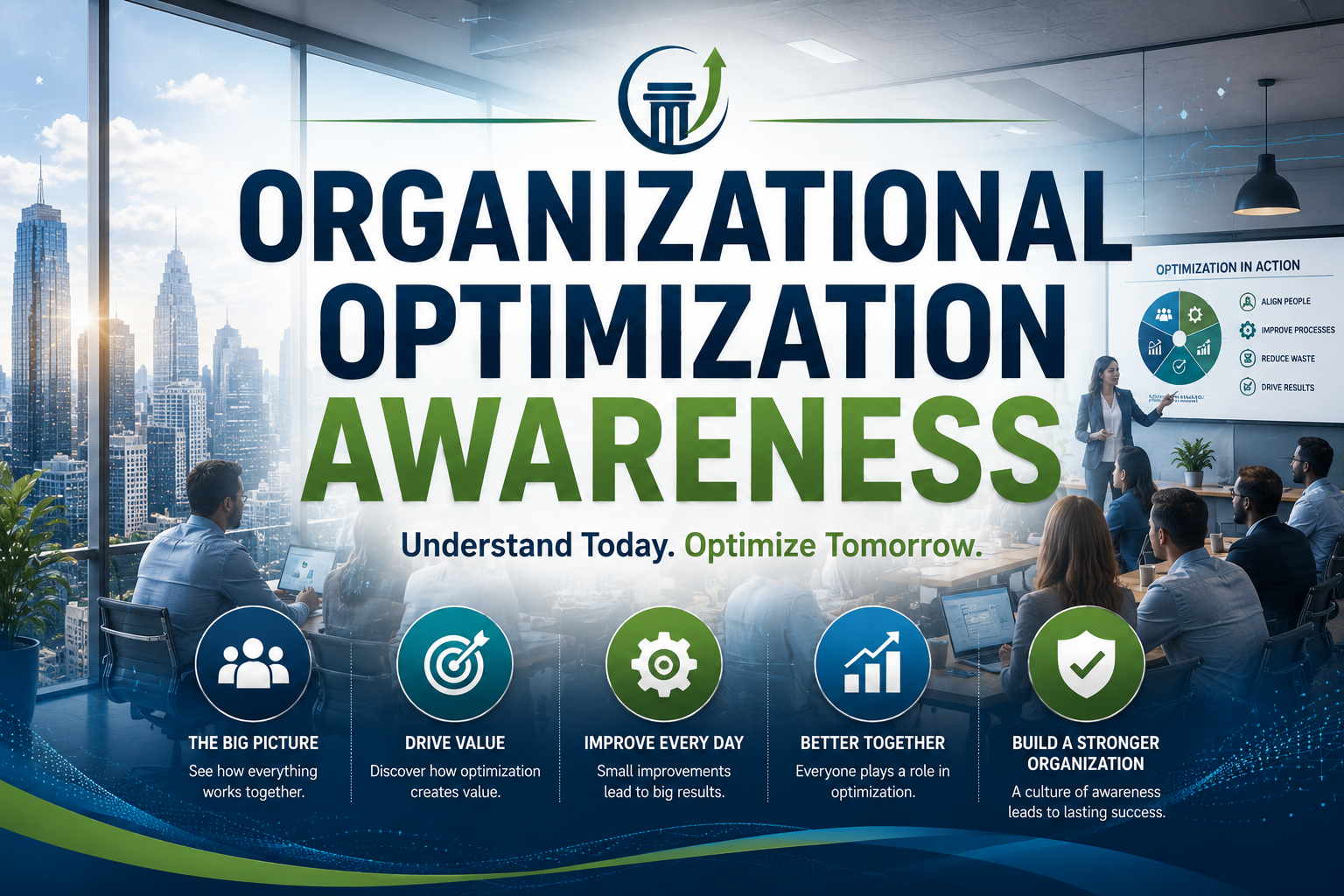
Understand the Organization. Understand Your Role. Contribute to Optimization.
The Organizational Optimization Awareness (OOA) Certification Program is a foundational professional development program designed to introduce employees, team members, supervisors, emerging leaders, and organizational stakeholders to the principles, language, concepts, and practices of Organizational Optimization. Organizational Optimization is not something accomplished by leadership alone. Every employee, every team, every process, every resource, and every organizational function contributes to the organization's ability to achieve its mission, execute its strategy, serve its customers and stakeholders, and continuously improve performance. The Organizational Optimization Awareness Program helps participants understand how organizations work as interconnected systems and how their individual responsibilities contribute to organizational success. The program establishes a common understanding of Organizational Optimization across the workforce and provides participants with the foundational knowledge necessary to actively support the organization's Journey to Optimization.
Why Take the Organizational Optimization Awareness Program?
Organizations perform best when employees understand more than the tasks associated with their individual positions. They understand the purpose behind the work. Employees need to understand where the organization is going, what it is trying to accomplish, how their responsibilities support organizational priorities, how their work affects others, and why continuous improvement matters. Without this understanding, organizations can experience communication breakdowns, organizational silos, duplicated efforts, competing priorities, inefficient processes, unclear responsibilities, wasted resources, inconsistent performance, and employees performing work without understanding how it contributes to organizational objectives. The Organizational Optimization Awareness Program helps establish a common organizational perspective. Participants learn how vision, strategy, leadership, people, processes, resources, technology, communication, performance, and risk must work together to achieve organizational results. Most importantly, participants learn where they fit within that system.
Everyone Has a Role in Organizational Optimization
Organizational Optimization is based on a simple but powerful principle:Every person and every organizational function contributes to organizational performance. Leadership may establish the vision. Strategy may establish the direction.Managers may establish priorities. Processes may define how work is performed. Technology may enable the work.Resources may support execution. But ultimately, people throughout the organization transform those elements into results.
The Organizational Optimization Awareness Program helps participants understand the connection:
Vision → Strategy → Organizational Priorities → Teams → Individual Responsibilities → Work → Performance → Results
When employees understand this connection, everyday activities become more meaningful because individuals can see how their work contributes to the organization's larger objectives.
What You Will Learn
Throughout the Organizational Optimization Awareness Program, participants develop a foundational understanding of the principles that support organizational excellence.
* Understanding Organizational Optimization - Learn what Organizational Optimization means and how it differs from traditional improvement initiatives. Participants are introduced to optimization as a continuous effort to align and improve the organization's people, processes, resources, technology, capabilities, performance, and risk management in support of strategic objectives.
* Understanding the Organization as a System - Organizations are not simply collections of independent departments. Participants learn how business functions, teams, processes, people, technology, resources, and decisions are interconnected. A change or problem in one part of the organization can influence performance elsewhere. Understanding these interdependencies helps employees make better decisions and collaborate more effectively.
* Understanding Vision and Strategy - Learn why organizational vision and strategy matter and how they establish the direction for organizational priorities and individual work. Participants learn to connect the question:“What am I doing?”with the more important question:“How does what I am doing contribute to what the organization is trying to accomplish?”
* Organizational Alignment - Understand why leadership, strategy, people, resources, processes, priorities, and performance must be aligned around common organizational objectives. Participants learn how misalignment can create organizational barriers and reduce performance.
* Organizational Effectiveness - Learn to ask: “Are we doing the right work?” Effectiveness focuses on whether activities contribute to the organization's mission, strategic priorities, customer requirements, and desired outcomes.
* Organizational Efficiency - Learn to ask: “Are we doing the work right?” Efficiency focuses on how effectively the organization uses its people, processes, technology, information, time, and other resources.
* Continuous Process Improvement - Participants are introduced to Continuous Process Improvement (CPI) and the importance of continually looking for better ways to perform work. Employees learn that improvement does not always require major transformation. Small improvements, consistently identified and implemented throughout the organization, can produce significant cumulative benefits.
* Communication and Collaboration - Understand why effective communication across teams and organizational functions is essential to optimization. Participants learn how organizational silos, incomplete information, and poor communication can negatively affect performance and why collaboration is necessary for enterprise success.
* Accountability and Ownership - Learn the importance of understanding responsibilities, performance expectations, organizational priorities, and individual accountability. Optimization requires employees to take ownership not only of completing assigned work but also of contributing to successful organizational outcomes.
* Performance and Results - Understand why organizations measure performance and how meaningful performance information helps determine whether activities are producing intended results. Participants learn the difference between being busy and producing value.
* Risk Awareness - Develop a foundational understanding that every employee has a role in recognizing and communicating risks that could affect organizational objectives, operations, customers, employees, resources, information, technology, or reputation.
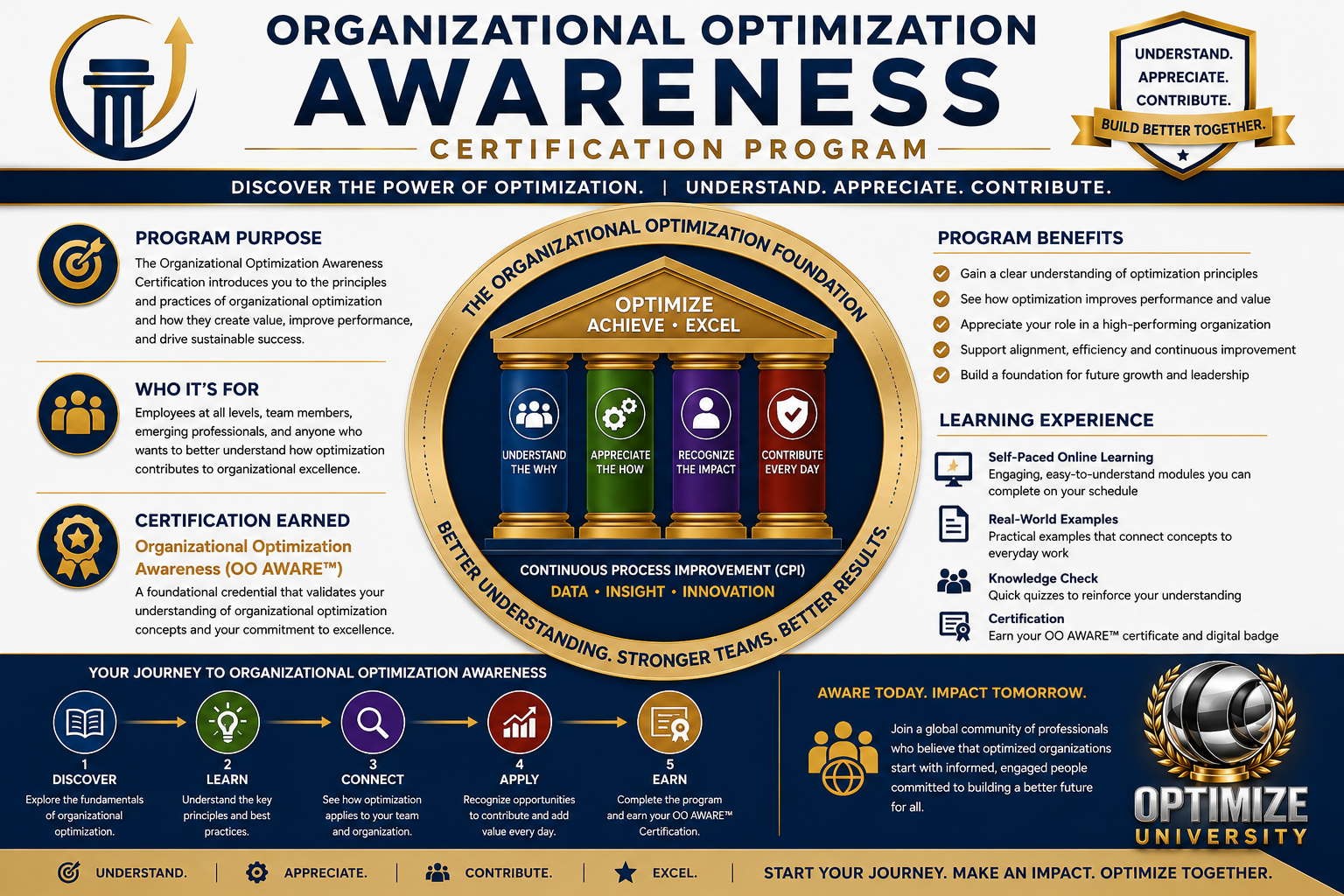
The Organizational Optimization Awareness Approach
The program introduces participants to a straightforward optimization mindset:
1. Understand Where We Are GoingKnow the organization's mission, vision, objectives, and priorities.
2. Understand Your RoleRecognize how your responsibilities contribute to those objectives.
3. Understand Your ConnectionsIdentify the people, processes, information, technology, and organizational functions that depend upon your work—and those upon which your work depends.
4. Do the Right WorkFocus effort on activities that contribute meaningful value to organizational objectives.
5. Do the Work RightLook for ways to improve quality, efficiency, consistency, and resource utilization.
6. Identify Opportunities for ImprovementRecognize unnecessary activities, recurring problems, communication barriers, process gaps, risks, and opportunities to perform work better.
7. Communicate and CollaborateShare information, concerns, ideas, lessons learned, and improvement opportunities with the appropriate people.
8. Take OwnershipAccept responsibility for individual performance and understand its contribution to team and organizational results.
9. Continuously ImproveRecognize that optimization is an ongoing journey rather than a one-time initiative.
From Doing Your Job to Understanding Your Contribution
Employees are frequently trained on what they are expected to do. Organizational Optimization Awareness adds another dimension: Why does the work matter? An employee may successfully complete every assigned task while the organization still fails to achieve the desired result. Optimization therefore requires participants to look beyond individual activities and understand how those activities contribute to broader outcomes.
The goal is to move from:
Task → Completion → Purpose → Task → Contribution → Performance → Organizational Result
This helps create a workforce that understands not simply how to perform its responsibilities, but how those responsibilities contribute to organizational success.
Who Should Enroll?
The Organizational Optimization Awareness Program is designed to provide a common foundation across the organization and is appropriate for: employees at all organizational levels, new employees, team members, frontline employees, supervisors, emerging leaders, administrative and support personnel, technical professionals, operations personnel, program and project team members, cross-functional teams, contractors and organizational partners where appropriate and employees preparing for advanced Organizational Optimization certifications. Because Organizational Optimization depends upon enterprise-wide participation, the Awareness Program can also serve as an effective organization-wide foundational training program before larger optimization, transformation, assessment, or Continuous Process Improvement initiatives are launched.
Program Outcomes
Upon successful completion of the Organizational Optimization Awareness Program, participants should be better prepared to:
* Explain the fundamental concepts of Organizational Optimization.
* Understand how organizational vision and strategy influence priorities and everyday work.
* Recognize the organization as an interconnected system rather than a collection of independent departments.
* Connect individual responsibilities with team, functional, and organizational objectives.
* Identify basic examples of organizational alignment and misalignment.
* Understand the difference between effectiveness and efficiency.
* Recognize opportunities for Continuous Process Improvement.
* Identify unnecessary activities, process barriers, communication problems, and potential performance gaps.
* Collaborate more effectively across teams and organizational functions.
* Understand the importance of accountability and individual ownership.
* Recognize how individual actions can influence organizational performance and risk.
* Contribute ideas and observations that support organizational improvement.
* Adopt a continuous improvement and optimization mindset.
Organizational Benefits
Organizations that provide Organizational Optimization Awareness training create a stronger foundation for enterprise improvement. When employees share a common understanding of optimization, leadership can communicate improvement priorities using a consistent language and framework. Employees become better equipped to understand why organizational changes are occurring, recognize how their work contributes to strategic objectives, identify improvement opportunities, and participate constructively in optimization initiatives.
An organization-wide awareness program can help:
* Strengthen understanding of organizational strategy.
* Improve communication between leadership and employees.
* Reduce organizational silos.
* Increase employee ownership and accountability.
* Strengthen cross-functional collaboration.
* Improve awareness of effectiveness and efficiency.
* Encourage identification of process improvement opportunities.
* Improve resource consciousness.Increase awareness of organizational risk.
* Support Continuous Process Improvement.
* Prepare employees for organizational change.
* Create a common language for Organizational Optimization.
Most importantly, the program helps establish the understanding that optimization is everyone's responsibility.
Creating an Optimization Culture
Organizational Optimization becomes sustainable when it moves beyond a leadership initiative and becomes part of the organization's culture. That requires employees who are willing and able to ask: Why are we doing this?, Does this activity support our organizational objectives?, Is there a better way to perform this work?, Are we using our resources effectively?, Who else is affected by what we do?, What risks or barriers should we communicate?, What can we improve?, When these questions become part of everyday organizational thinking, Continuous Process Improvement becomes more than a formal program. It becomes a way of working.
Everyone Contributes to the Journey to Optimization
Organizational Optimization begins with awareness. People must first understand the organization's objectives, recognize how the organization functions as an interconnected system, and understand how their individual contributions affect organizational performance. The Organizational Optimization Awareness Program provides that foundation. It helps transform employees from individuals who simply perform assigned tasks into organizational contributors who understand why their work matters, how their work connects to others, and how they can contribute to making the organization better.
Organizational Optimization Awareness (OOA) - Understand the Vision. Know Your Role. Connect Your Work. Identify Opportunities. Improve Continuously. Contribute to Organizational Excellence. Optimization Starts with Awareness—and Succeeds Through Participation.
This gives the program an important place at the beginning of the certification pathway:
Awareness creates understanding → Leadership creates sponsorship and direction → Alignment Specialists close tactical gaps → Architects design and implement optimization → Master Architects lead enterprise-wide optimization and transformation.
Optimize • Achieve • Excel
Meet the Instructor
Tim Fowler PhD