Organizational Alignment Specialist Certification Program
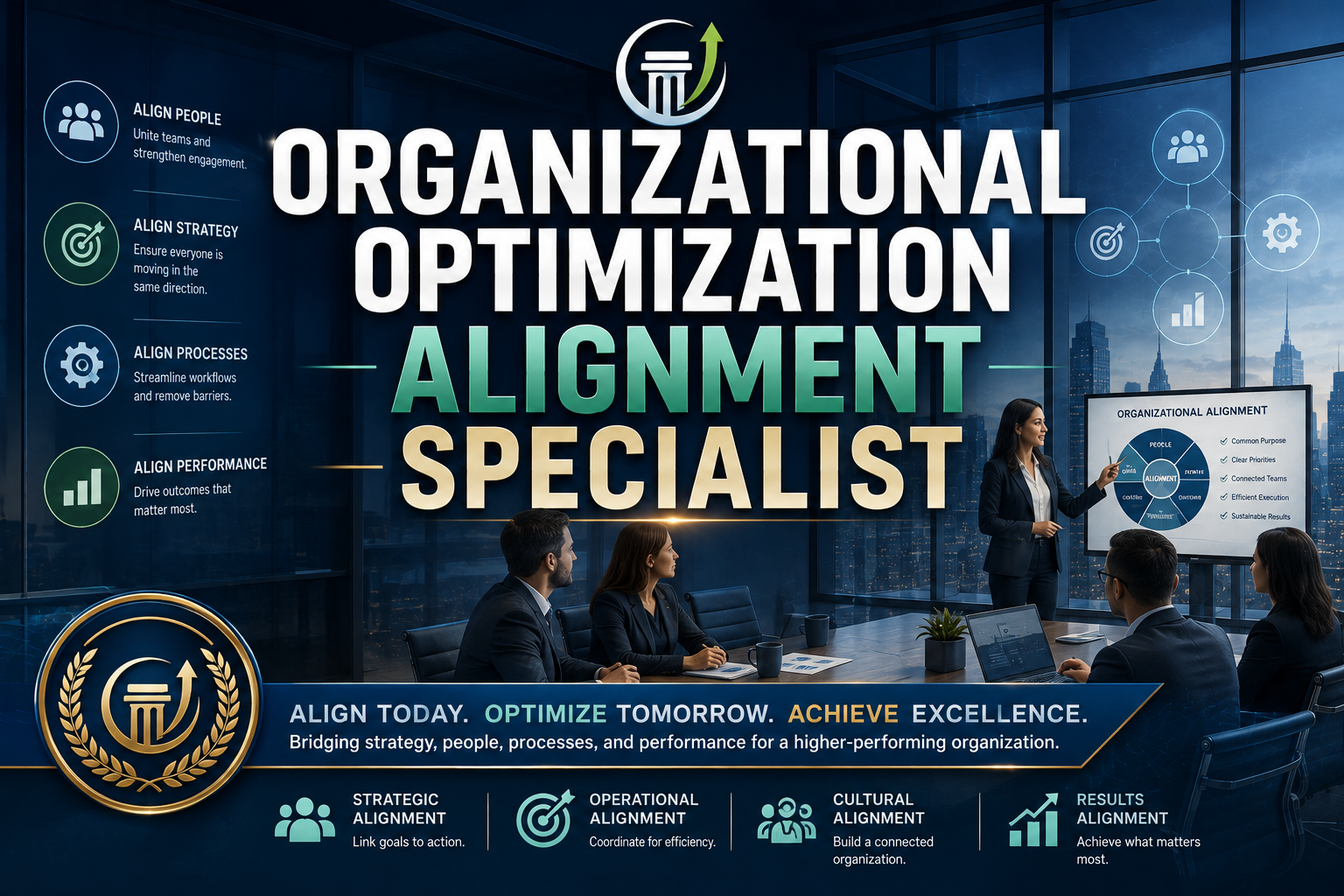
Turn Organizational Gaps into Measurable Improvement
The Organizational Alignment Specialist (OAS) Certification Program is a practical, application-focused certification designed to develop professionals who can identify, analyze, prioritize, and help close organizational alignment and performance gaps. The Organizational Alignment Specialist operates where assessment meets action. Organizational assessments can identify where an organization is misaligned, inefficient, ineffective, or underperforming. However, identifying a problem does not automatically improve performance. Organizations need professionals who understand how to take those findings, determine why the gaps exist, develop practical solutions, and facilitate improvement activities that produce measurable results. The OAS Certification provides participants with the Continuous Process Improvement (CPI) principles, methodologies, techniques, and tools necessary to move from identified organizational gaps to structured improvement. The goal is straightforward: Identify the Gap. Understand the Cause. Develop the Solution. Align the Organization. Improve the Result.
Why Take the Organizational Alignment Specialist Certification?
Organizations frequently experience a gap between what leadership intends and what actually occurs throughout the organization.Strategic priorities may not be clearly communicated. Departments may pursue competing objectives. Processes may no longer support organizational needs. Resources may be directed toward lower-value activities. Roles and responsibilities may be unclear. Performance measures may encourage behaviors that do not support the organization's strategic objectives. These conditions create organizational misalignment. Left unresolved, misalignment can lead to duplicated effort, wasted resources, poor communication, inconsistent execution, reduced accountability, slower decision-making, employee frustration, increased risk, and diminished organizational performance.
The Organizational Alignment Specialist learns how to systematically identify these conditions and facilitate improvement efforts designed to bring leadership, strategy, people, resources, processes, performance, and priorities into greater alignment.The Alignment Specialist's Role: From Assessment to ImprovementThe Organizational Alignment Specialist serves as an important link between organizational assessment findings and improvement implementation.Assessments tell the organization where gaps exist. The Alignment Specialist helps determine why those gaps exist and what should be done about them. Using Continuous Process Improvement principles and structured problem-solving methodologies, participants learn how to evaluate identified gaps, collect and analyze relevant information, identify root causes, develop potential solutions, establish improvement priorities, and support implementation.
The Alignment Specialist therefore helps transform:Assessment Findings → Gap Analysis → Root Cause Analysis → Improvement Priorities → Solutions → Implementation → Measurement → Continuous Improvement
What You Will Learn
Throughout the OAS Certification Program, participants develop practical competencies for facilitating organizational alignment and process improvement.
* Organizational Alignment - Learn how to evaluate whether organizational strategy, leadership priorities, people, resources, processes, responsibilities, and performance expectations are working together toward common organizational objectives.
* Gap Identification and Analysis - Learn how to examine assessment findings and determine the difference between the organization's current state and desired state. Participants learn to distinguish between symptoms and underlying organizational problems so improvement efforts address meaningful performance issues.
* Problem Identification and Definition - Develop the ability to clearly define organizational problems before attempting to solve them. Participants learn how to establish the scope, impact, stakeholders, performance implications, and measurable characteristics of an identified problem.
* Measurement and Data Analysis - Learn how to establish baseline performance, identify appropriate measures, collect relevant information, and use data to better understand organizational gaps.The objective is to move improvement decisions from assumptions toward evidence-based analysis.
* Root Cause Analysis - Learn how to move beyond visible symptoms and identify the underlying conditions contributing to organizational misalignment or performance problems. Participants apply structured techniques to determine why a problem is occurring, not simply where it appears.
* Solution Generation - Develop practical approaches for generating, evaluating, prioritizing, and recommending potential solutions. Solutions are considered based on factors such as expected impact, feasibility, organizational priorities, available resources, implementation requirements, risk, and sustainability.
* Continuous Process Improvement - Learn how CPI principles can be applied to organizational alignment challenges through a disciplined cycle of assessment, analysis, improvement, measurement, and refinement.
* Effectiveness and Efficiency - Alignment Specialists learn to examine two fundamental questions: 1) Are we doing the right work? — Effectiveness and 2) Are we doing the work right? — Efficiency. Both are necessary for organizational optimization.
* Facilitation and Stakeholder Engagement - Learn how to work with leaders, process owners, employees, subject-matter experts, and other stakeholders to understand problems, validate findings, develop solutions, and build support for improvement.
The Organizational Alignment Specialist Methodology
The OAS Certification teaches participants to approach organizational improvement through a structured process:
1. Understand the Organizational ObjectiveIdentify the strategic objective, organizational priority, performance expectation, or desired outcome associated with the area being assessed.
2. Review the Assessment FindingsExamine assessment results and supporting evidence to determine where significant gaps or misalignments exist.
3. Define the GapClearly describe the difference between the organization's current condition and its desired condition.
4. Measure the Current StateEstablish relevant baseline information and performance measures to understand the scope and impact of the problem.
5. Identify Root CausesDetermine the underlying factors contributing to the identified gap rather than simply treating its symptoms.
6. Develop SolutionsGenerate practical improvement alternatives that address identified root causes.
7. Prioritize ActionsEvaluate solutions according to organizational impact, strategic importance, feasibility, resources, risk, cost, and expected benefits.
8. Support ImplementationTranslate recommended solutions into defined improvement actions with responsibilities, milestones, measures, and expected outcomes.
9. Measure ResultsDetermine whether implemented improvements are closing the identified gap and producing the intended organizational results.
10. Continuously ImproveUse lessons learned, performance information, and feedback to refine solutions and identify additional opportunities for improvement.
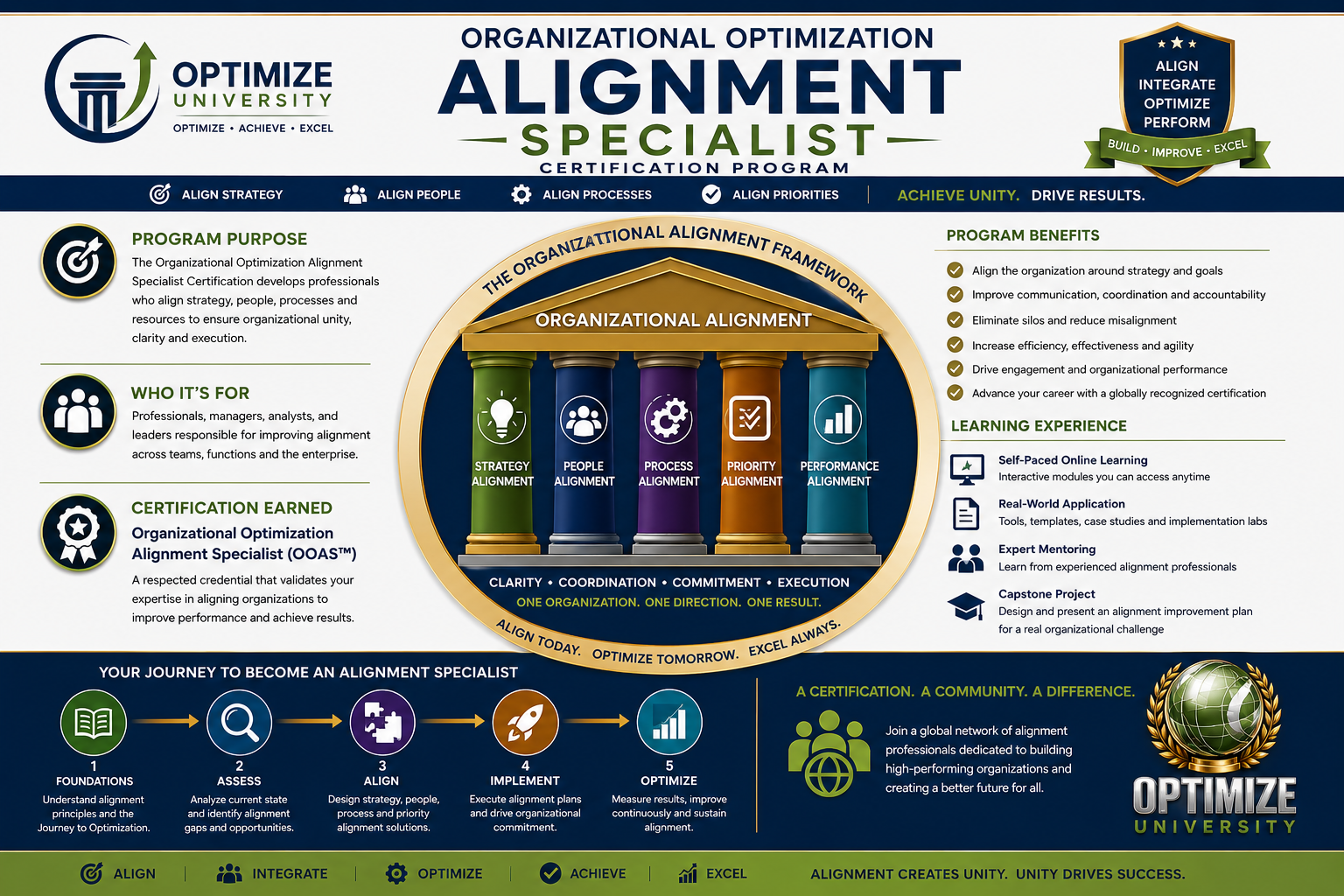
From the Classroom Into the Organization
The Organizational Alignment Specialist Certification emphasizes practical application rather than theory alone. Participants learn CPI concepts and tools in the classroom and then apply those techniques to realistic or actual organizational challenges. The organization becomes the application environment. Assessment findings become the starting point. Improvement becomes the objective. Participants learn how to take an identified organizational issue and progressively develop it into a structured Alignment Improvement Action Plan.
The Alignment Improvement Action Plan
A key outcome of the OAS Certification Program is the ability to develop an actionable improvement plan addressing identified organizational gaps. Depending upon the organizational challenge, the plan may include:
* Strategic or organizational objective
* Assessment finding Current-state condition and Desired-state condition
* Defined performance or alignment gap
* Baseline measurements
* Stakeholders and process owners
* Root causes and contributing factors
* Potential solutions
* Recommended corrective actions
* Prioritization criteria
* Roles and responsibilities
* Resource requirements
* Performance measures and KPIs
* Implementation milestones
* Expected organizational benefits
* Monitoring requirements
* Continuous improvement actions
The objective is to ensure that organizational assessments do not simply produce reports—they produce action.
Who Should Enroll?
The Organizational Alignment Specialist Certification is valuable for professionals involved in organizational performance, operations, improvement, and execution, including: team leaders and supervisors, managers and emerging leaders, continuous process improvement professionals, business and process analysts, program and project professionals, operations professionals, organizational development professionals, performance management professionals, quality and improvement professionals, human capital professionals, change-management professionals, internal and external consultants, government and military professionals, and professionals preparing for the Organizational Optimization Architect level.
Certification Outcomes
Upon successful completion of the Organizational Alignment Specialist Certification, participants should be better prepared to:
* Interpret organizational assessment findings and translate them into improvement opportunities.
* Identify gaps between current organizational performance and desired outcomes.
* Define problems clearly and establish appropriate scope.
* Measure current-state performance and establish meaningful baselines.
* Analyze organizational problems using structured CPI methodologies.
* Determine root causes rather than simply addressing symptoms.
* Generate practical solutions aligned with organizational priorities.
* Prioritize improvement opportunities according to impact, feasibility, resources, risk, and organizational value.
* Facilitate improvement activities involving multiple stakeholders.
* Develop actionable improvement recommendations and implementation plans.
* Measure whether corrective actions are producing the intended results.
* Support Continuous Process Improvement and ongoing organizational optimization.
Organizational Benefits
Organizations that develop certified Organizational Alignment Specialists gain professionals capable of helping convert assessment findings into structured, measurable improvement activities. Rather than allowing identified problems to remain unresolved or addressing symptoms through isolated corrective actions, Alignment Specialists bring a disciplined approach to determining what is wrong, why it is happening, what should change, and whether the change worked.
This capability can help organizations:
* Reduce organizational misalignment.
* Improve communication and coordination.
* Strengthen accountability.
* Eliminate unnecessary or low-value activities.
* Improve process effectiveness and efficiency.
* Better align resources with organizational priorities.
* Resolve recurring performance problems.
* Strengthen cross-functional collaboration.
* Improve execution of strategic priorities.
* Create a culture of continuous improvement.
Most importantly, Alignment Specialists help ensure that organizational assessments become a catalyst for improvement rather than simply a measurement exercise.
From Assessment to Action
Knowing that an organizational gap exists is only the beginning. Optimization occurs when the organization understands the problem, identifies its causes, implements the appropriate solution, measures the results, and continuously improves. The Organizational Alignment Specialist helps make that happen.
Organizational Alignment Specialist (OAS) - Identify the Gap. Measure the Problem. Find the Root Cause. Develop the Solution. Align the Organization. Improve the Result.
The Organizational Alignment Specialist turns assessment findings into improvement actions—and improvement actions into measurable organizational results. This also establishes a clear certification progression: Organizational Alignment Specialist → Organizational Optimization Architect → Organizational Optimization Master Architect, moving from tactical gap resolution and CPI, to organizational design and optimization blueprint development, to enterprise-level optimization leadership and transformation.
Optimize • Achieve • Excel
Meet the Instructor
Tim Fowler PhD