
Change Management for Leaders
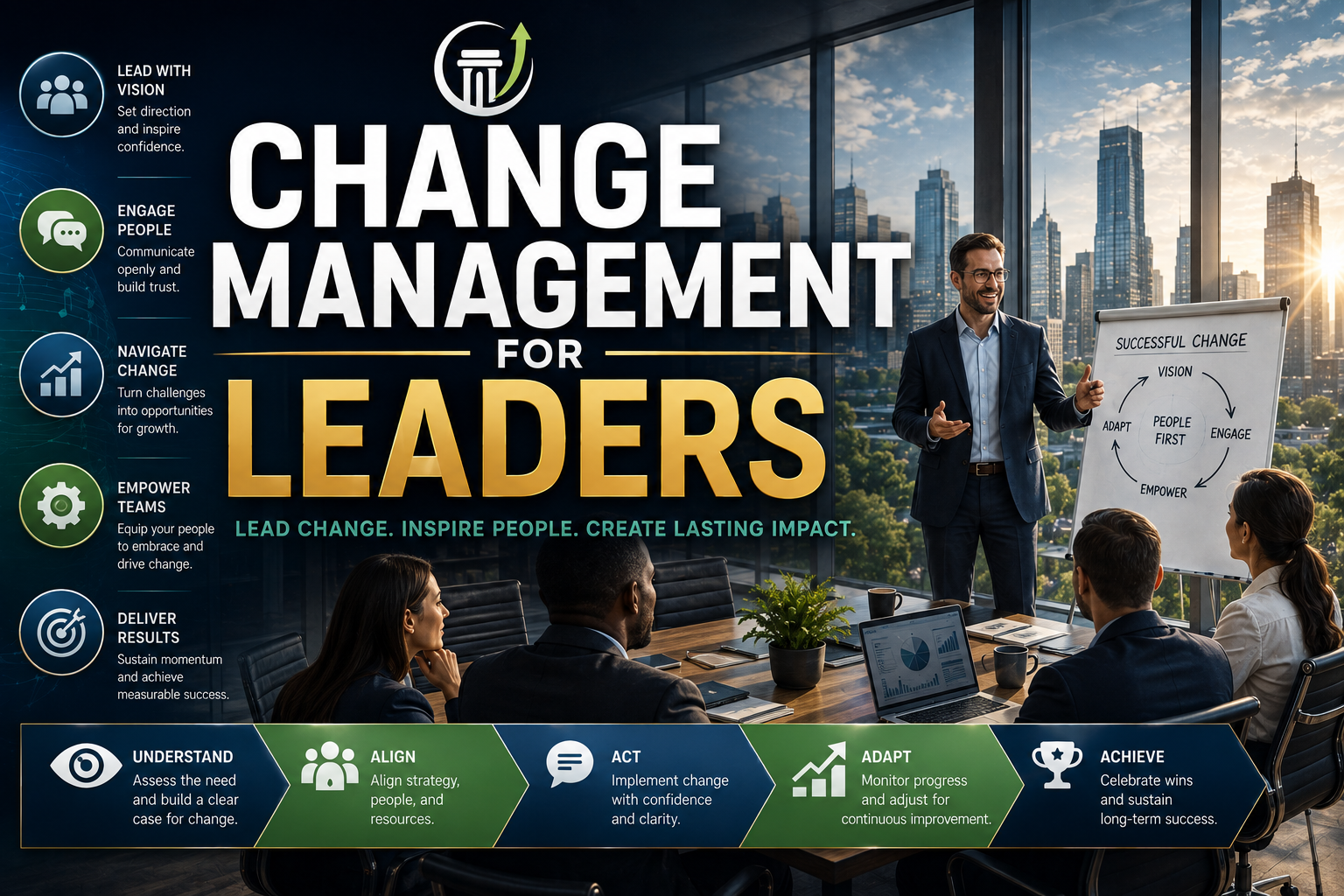
Lead the Change. Engage the Organization. Sustain the Transformation.
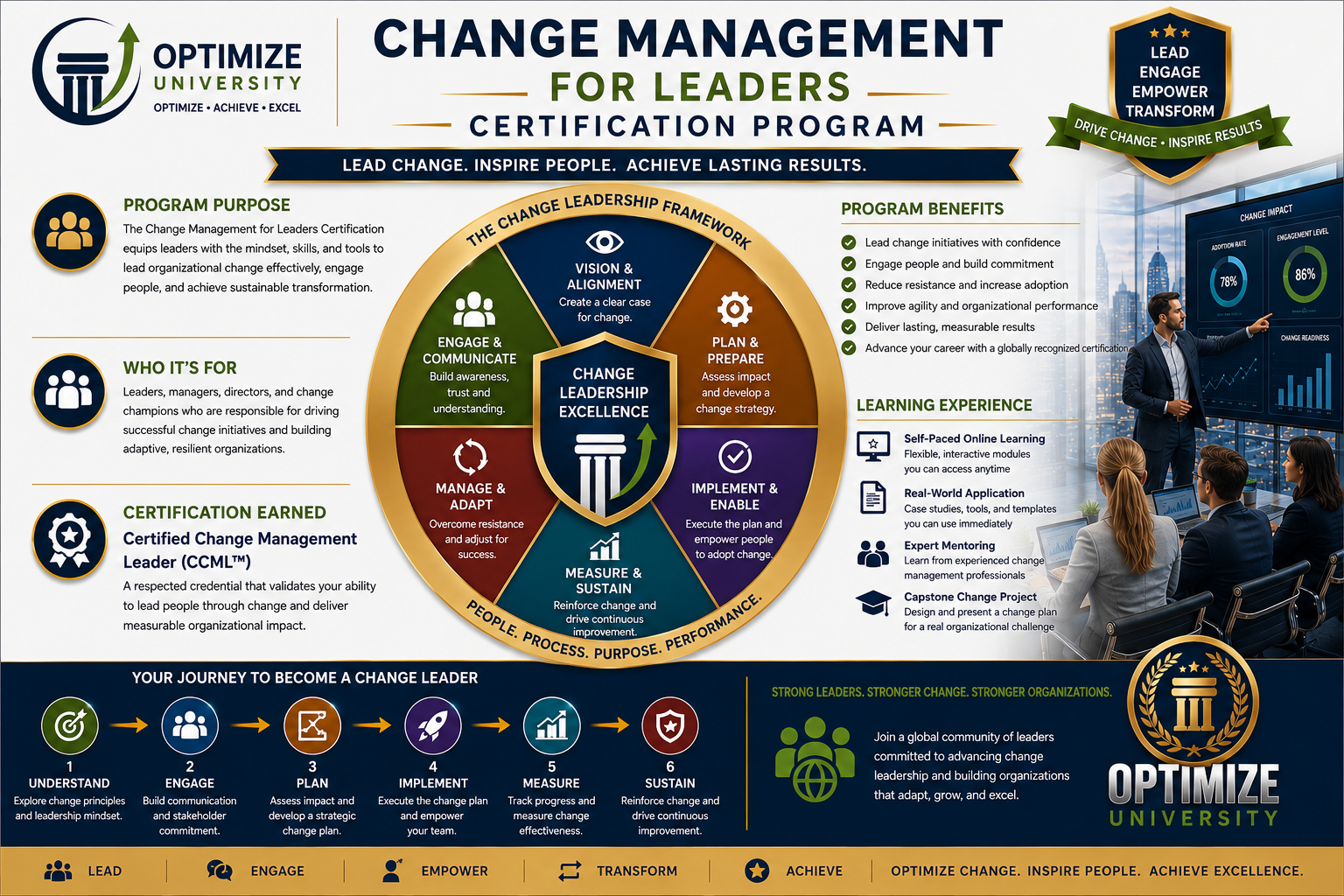
The Change Management for Leaders (CML) Certification Program is an intensive, two-day leadership development program designed to prepare executives, managers, supervisors, transformation leaders, and change sponsors to successfully lead people and organizations through meaningful change. The program utilizes a practical hybrid change-management methodology derived from professional experience, evidence-based leadership practices, and widely recognized change-management models and principles used throughout the world. Rather than relying exclusively on a single change methodology, the CML program integrates proven concepts into a flexible leadership framework that can be adapted to different organizations, cultures, industries, transformation initiatives, and levels of organizational complexity. Participants learn how to establish the case for change, create leadership alignment, communicate the vision, engage stakeholders, understand and address resistance, build organizational commitment, reinforce desired behaviors, measure adoption, and sustain the benefits of transformation. The objective is not simply to implement change. It is to develop leaders capable of helping people understand the change, accept the change, participate in the change, adopt the change, and ultimately sustain the change.
Why Take Change Management for Leaders?
Organizations are continually changing. New strategies are introduced. Technologies are implemented. Processes are redesigned. Organizations restructure. Leadership changes. New regulations emerge. Markets shift. Customer expectations evolve. Artificial intelligence transforms work. Mergers and acquisitions alter organizational structures. Optimization initiatives require employees to work differently.Yet even well-designed organizational changes can fail when the people side of transformation is not effectively led. A technically sound solution does not guarantee organizational adoption. Employees may not understand why change is necessary. Managers may communicate conflicting messages. Leaders may underestimate resistance. Employees may lack the knowledge or capability required to operate in the new environment. Organizational culture may reinforce old behaviors. Leadership attention may move to the next initiative before the change has been fully adopted. The result can be delayed implementation, employee resistance, lost productivity, reduced morale, increased costs, initiative fatigue, and failure to achieve the intended benefits of the transformation. The Change Management for Leaders Certification Program helps leaders address this challenge. Participants develop the leadership capabilities necessary to move an organization from: Current State → Transition → Adoption → Desired State → Sustained Performance
The Leader's Role in Organizational Change
Change management cannot simply be delegated to a project team, consultant, or Human Resources department. Leaders must lead the change. Employees look to leadership to understand:
* Why is the change necessary?
* What is changing?
* Why is it happening now?
* How will it affect me and my team?
* What will I be expected to do differently?
* What support will be available?
* What happens if we do not change?
* What will success look like?
The way leaders answer these questions can significantly influence whether employees resist, tolerate, accept, support, or actively champion organizational change. CML develops leaders who understand their responsibility to provide direction, clarity, communication, sponsorship, accountability, support, and reinforcement throughout the change journey.
Establishing the Case for Change
Learn how to clearly define why change is necessary and what organizational problem, opportunity, risk, or strategic objective is driving the transformation. Leaders must be able to create a compelling connection between: Why We Must Change → What Must Change → What Success Looks Like
Change Readiness
Learn how to evaluate whether the organization, leadership team, managers, employees, processes, systems, and culture are prepared for the proposed change.Understanding readiness enables leaders to identify potential barriers before implementation begins.Leadership AlignmentSuccessful transformation requires leaders to communicate and reinforce consistent priorities. Participants learn how to build leadership alignment around the purpose, direction, expectations, priorities, and desired outcomes of the change.
Stakeholder Analysis
Learn how to identify the people and groups affected by change and evaluate their influence, concerns, interests, expectations, and potential impact on implementation.
Change Impact Analysis
Understand how the proposed transformation may affect organizational structures, responsibilities, processes, technology, skills, behaviors, communication, culture, and performance expectations.
* Change Communication - Develop communication strategies that explain the purpose and benefits of change while providing employees with timely, relevant, credible, and understandable information. Effective communication is not a single announcement.It is an ongoing leadership responsibility.
* Resistance Management - Resistance is a natural component of organizational change. Participants learn how to recognize different forms and sources of resistance, understand underlying concerns, engage employees constructively, and determine appropriate leadership responses.The objective is not simply to eliminate resistance but to understand and manage it intelligently.
* Employee Engagement - Learn how participation, involvement, feedback, collaboration, and employee ownership can strengthen organizational commitment to change.
* Change Sponsorship - Understand the importance of visible and sustained executive sponsorship. Participants examine how leaders demonstrate commitment through decisions, behaviors, resource allocation, communication, accountability, and personal participation.
* Training and Capability Development - Learn how to identify the knowledge, skills, tools, and support employees need to successfully operate in the changed environment.
* Adoption and Reinforcement - Implementation is not complete when a new process, system, policy, or organizational structure is launched.The change must be adopted. Participants learn how leadership actions, performance expectations, recognition, accountability, coaching, measurement, and reinforcement help convert new practices into normal organizational behavior.
* Sustaining Change - Learn how to prevent organizations from reverting to previous behaviors after the initial implementation effort ends. Sustainable change requires continued leadership attention, measurement, accountability, reinforcement, and Continuous Process Improvement.
The Change Management for Leaders Methodology
The CML program teaches leaders to approach transformation through a structured change-leadership process:
1. Define the Need for ChangeClearly establish the organizational challenge, opportunity, risk, or strategic objective requiring transformation.
2. Establish the Desired StateDefine what the organization should look like after the change and identify the outcomes that will demonstrate success.
3. Assess Change ReadinessEvaluate leadership commitment, organizational capacity, stakeholder readiness, culture, resources, and potential implementation barriers.
4. Align LeadershipCreate agreement among leaders regarding the purpose, priorities, expectations, responsibilities, and outcomes of the transformation.
5. Identify Stakeholders and ImpactsDetermine who will be affected, how they will be affected, and what support they will require.
6. Develop the Change StrategyEstablish the communication, engagement, sponsorship, training, resistance-management, implementation, and reinforcement approaches necessary to support the transformation.
7. Communicate the ChangeProvide clear, consistent, credible, and ongoing communication throughout the organization.
8. Engage and Equip EmployeesProvide employees with the understanding, skills, resources, involvement, and support necessary to succeed.
9. Manage Resistance and BarriersIdentify emerging concerns and address organizational, cultural, operational, and individual barriers to adoption.
10. Implement and ReinforceEstablish accountability, recognize desired behaviors, monitor adoption, and reinforce new ways of working.
11. Measure Change EffectivenessDetermine whether employees are adopting the change and whether the transformation is producing its intended organizational benefits.
12. Sustain and Continuously ImproveIntegrate the change into organizational practices, performance expectations, culture, and Continuous Process Improvement.
From Change Management to Change Leadership
Change management provides methodologies, processes, plans, and tools.Change leadership provides the direction, influence, commitment, and organizational energy required to make those plans successful. The CML program emphasizes both. Participants learn that effective transformation requires:
* Management to organize the change.
* Leadership to mobilize the organization.
* A change plan may identify tasks, schedules, resources, milestones, and deliverables.
* Change leadership ensures people understand the purpose, believe leadership is committed, receive the support they need, accept responsibility for implementation, and remain engaged until the new way of working becomes sustainable.
From the Classroom Into the Organization
The Change Management for Leaders Certification Program emphasizes practical application. Throughout the two-day program, participants apply change-management principles to realistic or actual organizational transformation scenarios. Exercises progressively help participants examine: a) The case for change, b) Current and desired states, c) Change readiness, d) Stakeholder groups, e) Organizational impacts, f) Leadership responsibilities, g)Communication requirements, h) Potential resistance, i) Employee engagement, j) Training and capability requirements, k) Adoption measures, l) Reinforcement mechanisms, and m) Sustainability requirements. The learning progression becomes: Understand → Assess → Align → Communicate → Engage → Implement → Reinforce → Sustain
Developing the Change Leadership Action Plan
A primary practical outcome of the CML Certification Program is the development of a Change Leadership Action Plan. Depending upon the transformation initiative, the plan may include: the business case for change, current-state assessment, desired-state definition, change objectives, leadership alignment requirements, executive sponsor responsibilities, change readiness findings, stakeholder analysis, change impact assessment, communication strategy, employee engagement strategy, resistance-management approach, training and capability requirements, roles and responsibilities, implementation priorities, resource requirements, adoption measures, performance indicators, reinforcement activities, sustainability requirements, and continuous improvement actions. The objective is to ensure participants leave the course with more than an understanding of change-management theory.They leave with a structured approach for leading organizational change.
Who Should Enroll?
The Change Management for Leaders Certification Program is designed for professionals responsible for sponsoring, leading, managing, or influencing organizational change, including: C-suite executives, senior executives and directors, managers and supervisors, emerging leaders, organizational transformation leaders, change-management professionals, program and project managers, organizational optimization professionals, human capital and HR leaders, organizational development professionals, operations leaders, technology transformation leaders, continuous process improvement professionals, strategy professionals, government and military leaders, business owners and entrepreneurs and professionals preparing for greater leadership responsibilities.
Certification Outcomes
Upon successful completion of the Change Management for Leaders Certification Program, participants should be better prepared to:
* Explain the fundamental principles of organizational change and change leadership.
* Establish a compelling case for organizational change.
* Define the current state, transition requirements, and desired state.
* Assess organizational readiness for transformation.
* Align leaders around change objectives and expected outcomes.
* Identify stakeholders and evaluate the impact of change.
* Develop effective change communication strategies.
* Recognize and manage employee resistance.
* Engage employees and stakeholders throughout the transformation.
* Sponsor and champion organizational change.
* Identify training and capability-development requirements.
* Establish accountability for implementation and adoption.
* Measure whether the change is being adopted.
* Reinforce new organizational behaviors and practices.
* Sustain the intended benefits of organizational transformation.
* Integrate change management with Organizational Optimization and Continuous Process Improvement.
Organizational Benefits
Organizations with leaders trained in change management are better equipped to translate transformation initiatives into sustainable organizational results. Effective change leadership can help organizations:
* Improve employee understanding of organizational change.
* Strengthen leadership alignment.Increase stakeholder engagement.
* Identify resistance earlier.Reduce disruption during implementation.
* Improve employee adoption.Strengthen accountability.
* Improve communication across organizational levels.
* Accelerate transition to new ways of working.
* Reduce the risk of transformation failure.
* Improve realization of expected organizational benefits.
* Strengthen organizational adaptability and resilience.
* Support Continuous Process Improvement.
* Accelerate Organizational Optimization.
Most importantly, effective change leadership helps ensure that organizational transformation does not stop at implementation. It progresses to adoption, integration, and sustained organizational performance.
Creating a Change-Ready Organization
Organizations that thrive in rapidly changing environments develop more than the ability to execute individual change initiatives. They develop the organizational capability to adapt continuously. A change-ready organization encourages leaders and employees to ask:
* Why is change necessary?
* What organizational outcome are we trying to achieve?
* How will people be affected?
* What barriers could prevent adoption?
* What support do employees need?
* How will we know the change is working?
* What must leadership do to reinforce the change?
* How will we sustain the improvement?
When these questions become part of leadership thinking, change management moves beyond a project methodology and becomes an organizational capability.
Change Management and the Journey to Optimization
Change Management is a critical component of Organizational Optimization because optimization requires organizations to continually evolve. Assessments identify opportunities. Alignment establishes priorities. Architects design solutions. Leadership establishes direction. But Change Management helps people successfully transition from the current state to the desired state.
The relationship becomes: ASSESS → IDENTIFY → DESIGN → ALIGN → CHANGE → ADOPT → OPTIMIZE → SUSTAIN
Without effective change leadership, even the strongest optimization strategy may fail to achieve its intended results. Change Management for Leaders therefore provides an essential bridge between designing organizational improvement and successfully implementing it through people.
From Managing Change to Leading Transformation
Successful organizational transformation is ultimately measured by more than whether a new system was launched, a process was redesigned, or an organizational structure was changed. The true measure is whether people adopted the change and the organization achieved the intended benefits.
The Change Management for Leaders Certification Program prepares leaders to guide that journey. Change Management for Leaders (CML) Define the Change. Align the Leadership. Engage the People. Manage the Resistance. Enable the Adoption. Reinforce the Behavior. Sustain the Transformation. Change succeeds when people understand it, leaders champion it, employees adopt it, and the organization sustains it.
Optimize • Achieve • Excel
Meet the Instructor
Robert Hutcherson PhD