
Enterprise Risk Management III (Deployment) Certification Program
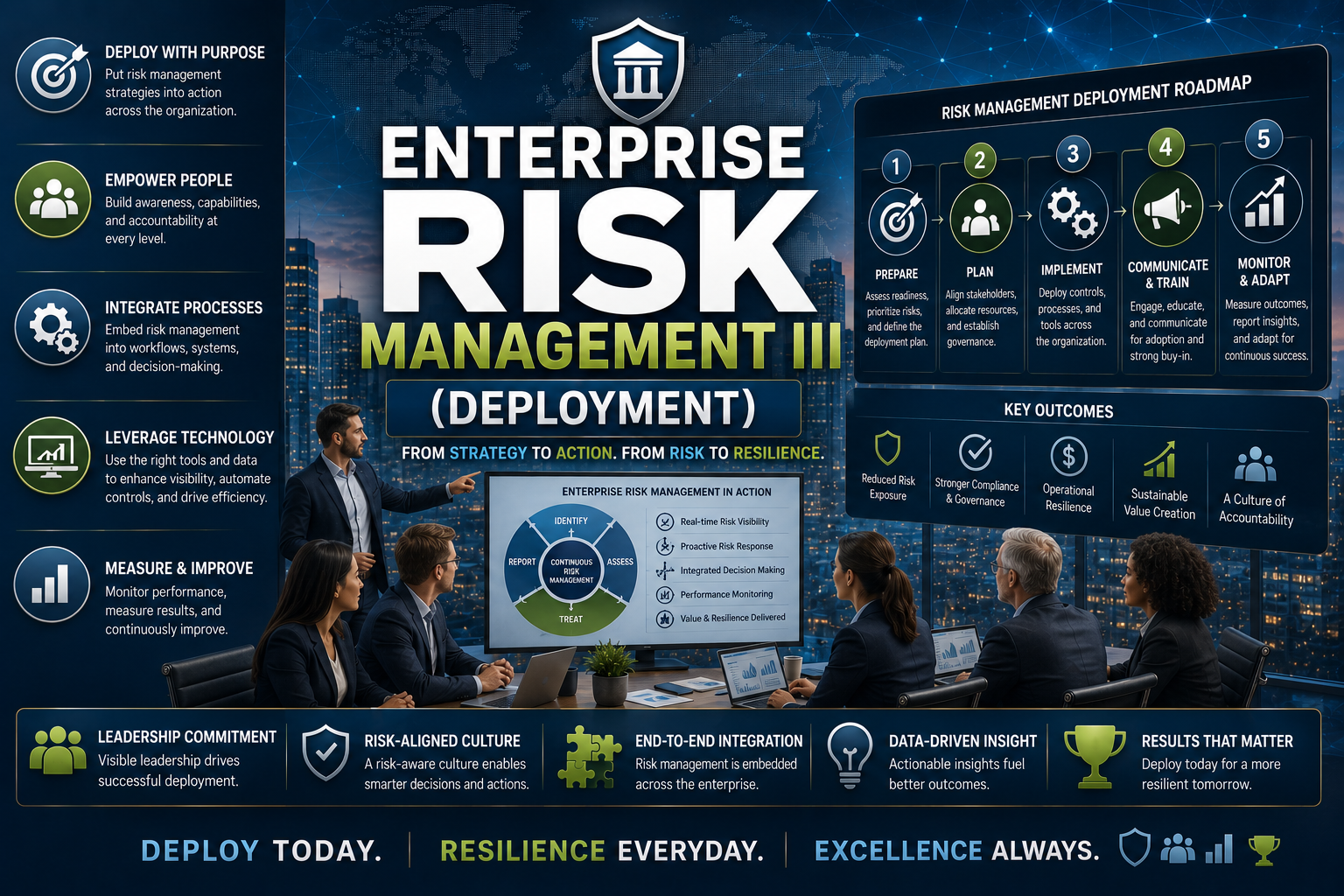
Transform Enterprise Risk Management from a Plan into an Organizational Capability
The Enterprise Risk Management III (Deployment) Certification Program is the third and culminating course in the three-part Enterprise Risk Management certification series. Building upon the ERM structure established in Enterprise Risk Management I (Structure) and the analytical and tactical capabilities developed in Enterprise Risk Management II (Tactical Application), ERM III prepares participants to deploy and operationalize an Enterprise Risk Management program across the organization. An ERM framework and Risk Register have limited value if they remain documents rather than becoming part of how the organization operates. ERM III addresses this critical challenge. The course provides participants with the methodologies, tools, governance practices, communication strategies, implementation techniques, and performance mechanisms necessary to move ERM from planning into execution and from execution into sustainable organizational practice. Participants learn how to integrate risk management into leadership, strategy, operations, programs, projects, resource allocation, performance management, and organizational decision-making. Through structured instruction and practical exercises, participants progressively develop the components necessary to deploy an ERM program within an organization. By the conclusion of ERM III, participants should be prepared to help transform Enterprise Risk Management from an isolated risk-management activity into an integrated enterprise management capability.
Why Take Enterprise Risk Management III?
Organizations can invest significant time developing risk policies, frameworks, assessments, Risk Registers, and mitigation plans yet still fail to effectively manage enterprise risk. The problem is often not the quality of the ERM framework. The problem is deployment. Risk management must become part of how leaders make decisions, how managers establish priorities, how resources are allocated, how programs are executed, how performance is evaluated, and how employees identify and communicate emerging concerns.
Without effective deployment:
* Risk Registers become static documents.
* Mitigation plans lose momentum.
* Risk owners may not understand their responsibilities.
* Leadership may receive risk information too late.
* Departments may continue managing risks independently.
* Risk information may not influence strategic decisions.
* Emerging risks may remain unidentified.
* Mitigation actions may not be measured.
* Lessons learned may not improve future decisions.
ERM III teaches participants how to overcome these challenges by establishing the organizational mechanisms necessary to implement, operate, govern, and sustain Enterprise Risk Management.
From ERM Planning to ERM Deployment
Enterprise Risk Management becomes valuable when risk information influences organizational action.
ERM III focuses on the transition: ERM Framework → Risk Analysis → Risk Priorities → Deployment → Integration → Governance → Monitoring → Decision-Making → Continuous Improvement
The objective is to make risk management an ongoing component of organizational management rather than an occasional assessment or compliance exercise. Participants learn how to connect enterprise risks with the people, processes, resources, decisions, and leadership actions necessary to manage them.
What You Will Learn
Throughout ERM III, participants develop practical capabilities for deploying and sustaining an enterprise-wide risk-management program. * *
* ERM Deployment Planning - Learn how to translate the ERM framework, Risk Register, mitigation strategies, and governance requirements developed during earlier phases into an actionable deployment plan. Participants examine implementation priorities, sequencing, organizational readiness, stakeholders, resources, responsibilities, milestones, and expected outcomes.
* ERM Governance - Learn how to operationalize the governance structure established during ERM I. Participants examine the roles of the Board, C-suite, executive leadership, ERM leadership, risk committees, business units, risk owners, mitigation owners, and employees in maintaining an effective ERM capability.
* Leadership Engagement - ERM succeeds when leadership actively uses risk information.Participants learn how to engage senior leaders in reviewing enterprise risk exposure, establishing priorities, making risk-informed decisions, allocating resources, resolving barriers, and holding risk owners accountable.
* Risk Ownership and Accountability - Learn how to operationalize risk ownership throughout the organization.Participants examine how responsibilities should be assigned, communicated, monitored, and escalated so significant risks and mitigation activities have clearly accountable owners.
* ERM Communication - Develop communication strategies that establish a common understanding of enterprise risk across the organization. Effective ERM communication should ensure that:Leadership understands significant enterprise risks.Risk owners understand their responsibilities. Employees understand how to identify and communicate emerging risks.Decision-makers receive meaningful risk information when they need it.
* Risk Reporting - Learn how to transform detailed risk information into concise, decision-relevant reporting for different organizational audiences. Participants examine approaches for communicating risk priorities, mitigation status, emerging concerns, trends, residual exposure, and issues requiring leadership action.
* Risk Escalation - Develop clear criteria and pathways for determining when risks should be elevated to higher levels of management. Effective escalation ensures significant changes in exposure receive appropriate attention before they become organizational crises.
* Mitigation Implementation - ERM II develops mitigation strategies.ERM III focuses on executing them. Participants learn how to translate mitigation plans into accountable actions with defined owners, resources, milestones, completion requirements, and measures of effectiveness. * Key Risk Indicators - Learn how Key Risk Indicators (KRIs) can provide early warning that organizational risk exposure may be increasing. Participants examine how KRIs can support proactive management by identifying changes before unacceptable consequences occur.
* Performance Measurement - Develop methods for determining whether the ERM program itself is producing value. Participants learn to evaluate whether risks are being identified earlier, mitigation actions are being completed, exposure is being reduced, risk decisions are improving, and ERM is contributing to organizational resilience and performance.
* ERM Integration - Learn how to integrate risk considerations into existing organizational processes, including: strategic planning, budgeting and resource allocation, operational planning, program and project management, performance management, technology management, human capital management, supply-chain management, change management, business continuity, continuous process improvement, and organizational optimization.
The goal is to make risk management part of how the organization operates, rather than creating a separate administrative process.Emerging Risk ManagementLearn how organizations can identify and evaluate new risks resulting from changes in technology, markets, regulations, workforce conditions, geopolitical environments, supply chains, competitors, customer expectations, and other external factors.Continuous ERM ImprovementUnderstand how lessons learned, performance information, organizational changes, incidents, near misses, emerging risks, and leadership feedback should continuously improve the ERM program.
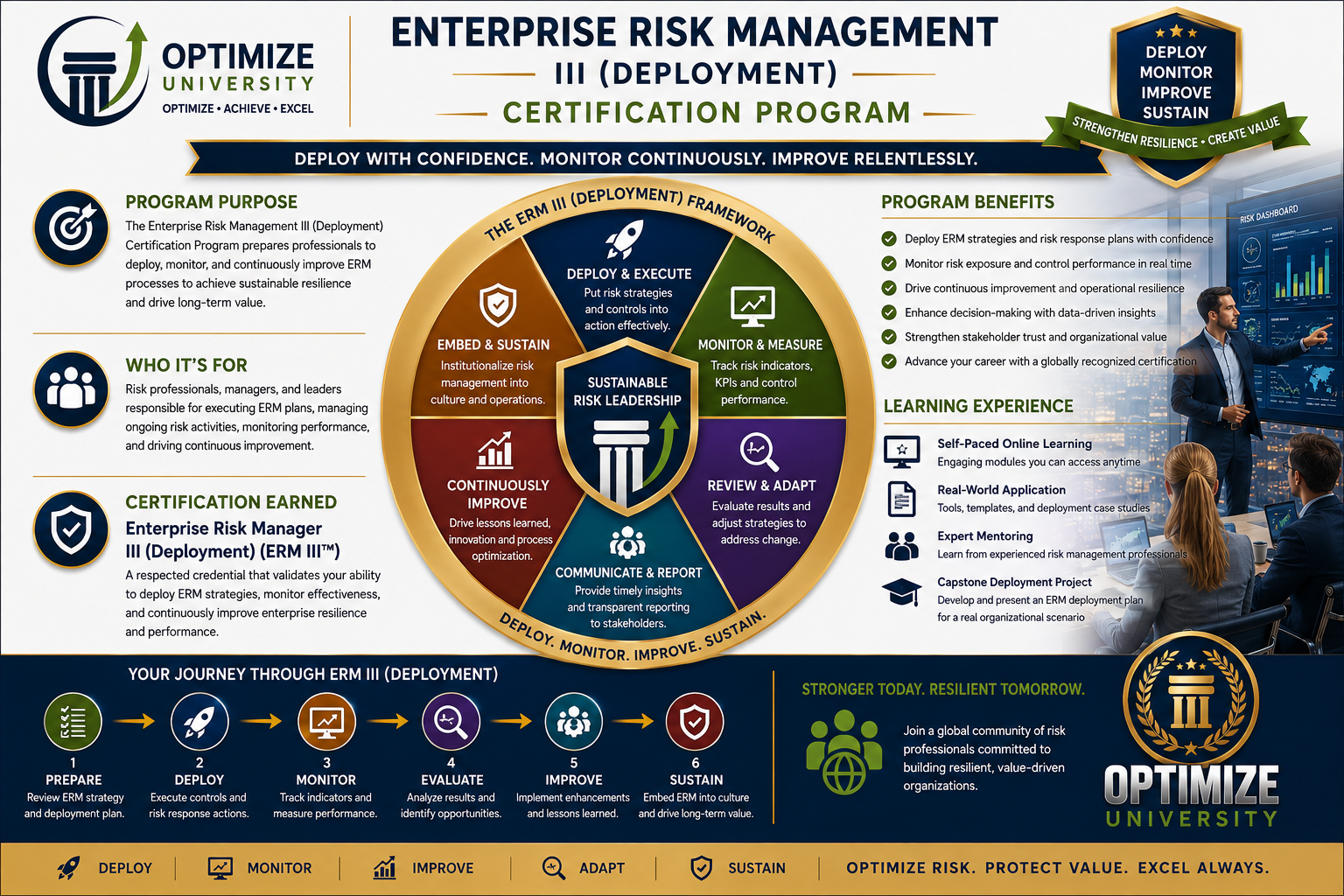
The ERM III Deployment Methodology
Participants learn to deploy Enterprise Risk Management through a structured process:
1. Confirm ERM ReadinessReview the ERM framework, governance structure, Risk Register, risk priorities, mitigation strategies, organizational capabilities, and leadership commitment.
2. Develop the Deployment StrategyDetermine how ERM will be introduced, sequenced, communicated, resourced, and implemented throughout the organization.
3. Activate GovernanceEstablish operational risk committees, leadership oversight, decision authority, reporting responsibilities, and escalation pathways.
4. Assign and Confirm OwnershipEnsure every significant enterprise risk and mitigation action has a clearly accountable owner.
5. Communicate the ERM ProgramEducate leaders, managers, employees, and stakeholders regarding the purpose of ERM and their responsibilities within the process.
6. Execute Mitigation StrategiesTranslate risk-response plans into specific actions, resources, responsibilities, milestones, and measurable outcomes.
7. Integrate ERM into Organizational ProcessesEmbed risk considerations into strategy, planning, budgeting, operations, programs, projects, performance management, and decision-making.
8. Establish Risk ReportingDevelop reporting mechanisms that provide leadership with timely and actionable risk intelligence.
9. Monitor Risk and Mitigation PerformanceUse KRIs, performance indicators, milestones, trends, and other information to evaluate changing exposure and mitigation effectiveness.
10. Escalate Significant RisksEnsure emerging or increasing risks reach the appropriate level of leadership for timely action.
11. Evaluate Program EffectivenessDetermine whether ERM processes are improving organizational decision-making, resilience, and performance.
12. Continuously Improve ERMUse lessons learned, assessments, performance results, and organizational changes to continuously strengthen the program.
From the Classroom Into the Enterprise
Like ERM I and ERM II, Enterprise Risk Management III emphasizes practical application. Participants do not simply study how ERM should be deployed. They develop the components necessary to deploy it. Each major stage of the deployment process includes a corresponding exercise that progressively builds the participant's Enterprise Risk Management Deployment Plan. The learning progression becomes:
Plan → Deploy → Integrate → Execute → Monitor → Govern → Improve
The objective is to ensure participants leave the course prepared to take the ERM structures, analyses, risk registers, and mitigation strategies developed through the certification series and put them into operation.
Developing the ERM Deployment Plan
A primary practical outcome of ERM III is the development of an Enterprise Risk Management Deployment Plan. Depending upon organizational requirements, the plan may include:
* ERM deployment objectives
* Organizational readiness assessment
* Deployment scopeImplementation priorities
* ERM governance structure
* Executive sponsorship
* Risk committee responsibilities
* Risk-owner assignments
* Mitigation-owner assignments
* Stakeholder identification
* Communication strategy
* ERM education and awareness requirements
* Deployment sequencing
* Resource requirements
* Implementation milestones
* Risk-reporting structure
*Escalation criteria
* Key Risk Indicators
* ERM performance measures
* Risk review cycles
* Leadership reporting requirements
* Integration with strategic planning
* Integration with operational processes
* Continuous improvement requirements
* ERM maturity objectives
The Deployment Plan becomes the roadmap for transforming ERM from a designed framework into an operating enterprise capability.
Building an Enterprise Risk Management Operating Rhythm
Effective ERM requires a repeatable management rhythm. Risk cannot be reviewed once a year and expected to remain current. Organizations continually change, and their risk environment changes with them. ERM III teaches participants how to establish recurring processes for: Identifying new and emerging risks.Reviewing significant enterprise risks.Evaluating mitigation progress.Monitoring Key Risk Indicators.Reassessing likelihood and impact.Evaluating residual risk.Escalating changing risk conditions.Reporting significant exposures to leadership.Reviewing resource requirements.Evaluating the effectiveness of risk responses.Updating the Enterprise Risk Register.Identifying opportunities for continuous improvement.This operating rhythm helps transform ERM from a periodic exercise into an ongoing management discipline.
Integrating Risk into Decision-Making
One of the most important outcomes of ERM deployment is improving organizational decision-making. Before significant decisions are made, leaders should understand: What are we trying to accomplish?, What assumptions are we making?, What could prevent success?, What opportunities could improve the outcome?, What is our level of exposure?, Does this exposure fall within our risk appetite and tolerance?, What actions could reduce the risk?, What resources are required?, What residual risk will remain?, Who is accountable?, How will we monitor the outcome?, When these questions become part of organizational decision-making, ERM moves beyond risk reporting and becomes a strategic leadership capability.
Who Should Enroll?
Enterprise Risk Management III is designed for professionals responsible for implementing, governing, operating, or sustaining organizational risk-management programs, including: enterprise risk professionals, executives and senior leaders, ERM program leaders, risk managers, and risk owners, managers and supervisors, strategy professionals, program and project leaders, operations professionals, compliance professionals, internal audit professionals, financial professionals, cybersecurity and technology professionals, supply-chain and procurement professionals, business continuity professionals, organizational optimization professionals, government and military leaders, business owners and entrepreneurs, and professionals pursuing Enterprise Risk Manager certification. Participants should ideally have completed ERM I (Structure) and ERM II (Tactical Application) or possess equivalent ERM knowledge and experience.
Certification Outcomes
Upon successful completion of Enterprise Risk Management III, participants should be better prepared to:
* Develop an Enterprise Risk Management Deployment Plan.
* Deploy an ERM framework across organizational functions.
* Operationalize ERM governance structures.
* Engage leadership in risk-informed decision-making.
* Establish clear risk ownership and accountability.Implement risk mitigation strategies.
* Integrate ERM into strategic and operational management processes.
* Develop meaningful enterprise risk reporting.
* Establish risk escalation criteria and communication pathways.
* Use Key Risk Indicators to monitor changing exposure.
* Evaluate residual risk and mitigation effectiveness.
* Monitor implementation progress and enterprise risk trends.
* Identify and communicate emerging risks.
* Measure the effectiveness of the ERM program.
* Establish an ongoing ERM operating rhythm.
* Continuously improve the organization's risk-management capability.
* Support the development of a risk-aware organizational culture.
Organizational Benefits
Organizations with professionals trained in ERM deployment gain the capability to move beyond risk-management documentation toward enterprise-wide risk-informed management. Effective ERM deployment can help organizations:
* Improve leadership visibility into significant enterprise risks.
* Strengthen risk-informed strategic decision-making.
* Create clearer accountability for risk ownership.
* Improve execution of mitigation strategies.
* Identify emerging risks earlier.
* Strengthen communication across organizational functions.
* Improve allocation of risk-management resources.
* Integrate risk considerations into strategy and operations.
* Strengthen organizational resilience.
* Improve preparedness for uncertainty and disruption.
* Reduce fragmented risk-management practices.
* Create stronger connections between risk, performance, and organizational objectives.
* Support Continuous Process Improvement.
* Strengthen Organizational Optimization.
Most importantly, ERM III helps ensure that Enterprise Risk Management becomes something the organization does, rather than simply something the organization documents.
Creating a Risk-Aware Organizational Culture
The ultimate objective of ERM deployment is not simply implementing another management process. It is creating an organization where risk awareness becomes part of how people think, communicate, plan, and make decisions. In a risk-aware organization:
* Employees recognize and communicate emerging concerns.
* Managers understand the risks associated with their objectives.
* Risk owners actively manage their assigned exposures.
* Leadership considers risk when establishing priorities and allocating resources.
* Significant risks are escalated before they become crises.
* Mitigation activities are measured for effectiveness.
* Lessons learned improve future decisions.
* Risk and opportunity are considered together.
* Enterprise Risk Management becomes integrated into organizational performance.
This is when ERM moves from a program to an organizational capability.
Completing the Enterprise Risk Management Certification Journey
Enterprise Risk Management III completes the three-part ERM certification pathway. Each program develops a distinct but interconnected capability:
ERM I (Structure) - Build the ERM Foundation. Establish governance, roles, responsibilities, terminology, risk categories, assessment criteria, and the organizational ERM framework.
ERM II (Tactical) - Work the Risks. Identify, analyze, assess, prioritize, respond to, mitigate, document, and monitor enterprise risks.
ERM III (Deployment) - Operationalize ERM Across the Enterprise.Deploy governance, execute mitigation strategies, integrate risk into organizational processes, establish reporting and escalation, monitor enterprise exposure, engage leadership, and continuously improve the ERM program.
Together, the progression becomes:
STRUCTURE → ASSESS → PRIORITIZE → MITIGATE → DEPLOY → INTEGRATE → MONITOR → IMPROVE
The result is a professional prepared to help an organization move from simply understanding enterprise risk to developing a structured, actionable, integrated, and sustainable Enterprise Risk Management capability.
From Risk Management Program to Enterprise Management Capability
The true measure of an ERM program is not the number of risks contained in a Risk Register. It is whether the organization is making better decisions because it understands its risks. Enterprise Risk Management III prepares participants to make that transition. The goal is to create an ERM capability that provides leadership with the information, governance, accountability, processes, and organizational awareness necessary to make better-informed decisions while protecting and advancing organizational objectives.
Enterprise Risk Management III (Deployment) - Deploy the Framework. Activate Accountability. Execute the Mitigation. Integrate the Enterprise. Monitor the Risk. Inform the Decision. Continuously Improve.
ERM III transforms Enterprise Risk Management from a plan into an operating organizational capability.
Optimize • Achieve • Excel
Meet the Instructor
Steven Bradt