
Enterprise Risk Management I (Structure)
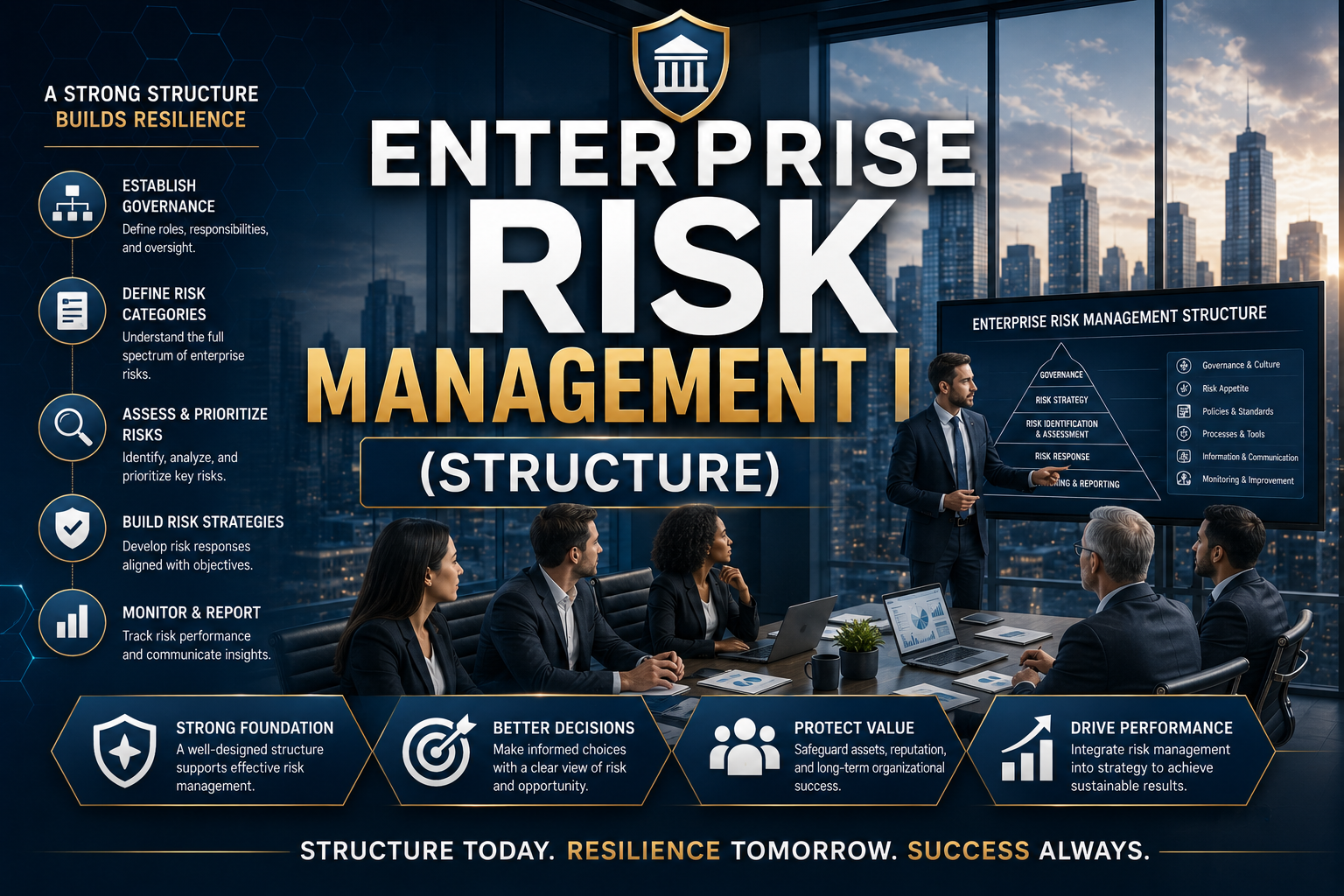
Build the Foundation for Effective Enterprise Risk Management
The Enterprise Risk Management I (Structure) Certification Program is the foundational course in the three-part Enterprise Risk Management certification series. It is designed to provide executives, managers, risk professionals, program leaders, and organizational practitioners with the knowledge and practical tools necessary to establish the structure and framework for an effective Enterprise Risk Management (ERM) program. Effective risk management does not begin with a risk register. It begins with structure. Organizations must first establish how risk will be governed, who will be responsible, how risks will be identified and communicated, how risk decisions will be made, and how risk management will connect with organizational strategy and performance. ERM I provides this foundation. Through structured instruction and practical exercises, participants progress through the essential steps required to establish an organizational ERM framework. Each major component of the course includes an application exercise designed to help participants move beyond theoretical understanding and begin developing the components of an actual Enterprise Risk Management Plan. By the conclusion of the course, participants are prepared to advance from understanding ERM concepts to the more tactical activities of risk identification, assessment, prioritization, response, mitigation, and monitoring addressed throughout the broader ERM certification pathway.
Why Take Enterprise Risk Management I?
Every organization faces risk. Strategic decisions create risk. Operations create risk. Technology creates risk. People create risk. Financial decisions create risk. Vendors and supply chains create risk. Regulatory requirements create risk. Organizational change creates risk. The question is not whether an organization has risk. The question is whether the organization has a disciplined, enterprise-wide structure for understanding and managing it. Without an established ERM framework, risk management can become fragmented and reactive. Individual departments may manage risks differently. Critical risks may not reach senior leadership. Responsibilities may be unclear. Risks may be evaluated inconsistently. Mitigation resources may be directed toward lower-priority concerns while significant enterprise threats remain insufficiently addressed. Enterprise Risk Management I helps establish the organizational foundation necessary to prevent this fragmented approach. Participants learn how to create a structured ERM environment in which risk becomes an integrated component of leadership, governance, strategy, decision-making, operations, performance, and organizational optimization.
Enterprise Risk Management Begins with Structure
An effective ERM program requires more than identifying potential problems.It requires an organizational system for managing uncertainty. ERM I introduces participants to the fundamental relationship:
Mission → Vision → Strategy → Objectives → Risk → Decisions → Actions → Performance
Every strategic objective contains uncertainty. Enterprise Risk Management helps leadership understand that uncertainty, evaluate its potential impact, establish appropriate responses, allocate resources, and make better-informed decisions. The objective is not to eliminate all risk. Organizations cannot innovate, grow, transform, or pursue opportunities without accepting some degree of uncertainty. The objective is to develop the organizational capability to understand risk, make informed decisions about risk, and manage risk within acceptable boundaries while pursuing organizational objectives.
What You Will Learn
Throughout Enterprise Risk Management I, participants develop a foundational understanding of the elements necessary to establish an effective ERM program.
Understanding Enterprise Risk Management
Learn the fundamental principles of ERM and how enterprise risk management differs from isolated, departmental, compliance-driven, or reactive risk-management approaches. Participants examine risk from an enterprise perspective and learn why risk should be considered in the context of organizational objectives. Establishing the ERM FrameworkLearn the foundational components required to create a structured and repeatable ERM program. Participants examine how governance, policies, processes, responsibilities, reporting, assessment criteria, and leadership oversight work together to establish an enterprise risk capability. Risk Governance - Understand how Boards of Directors, C-suite executives, senior leaders, risk owners, managers, and employees contribute to effective risk management. Participants learn the importance of establishing clear ownership, decision authority, escalation requirements, accountability, and oversight.
Roles and Responsibilities
Learn how to establish clear responsibilities for identifying, assessing, managing, reporting, monitoring, and escalating enterprise risks.Risk management works best when individuals understand not only who owns a risk, but who is responsible for managing the actions associated with that risk.
Risk Categories
Participants are introduced to the major categories of enterprise risk that may affect organizational objectives, including:
* Strategic risk
* Operational risk
* Financial risk
* Technology and cybersecurity risk
* Human capital risk
* Legal and compliance risk
* Supply-chain and third-party risk
* Reputational risk
* Project and program risk
* Business continuity risk
* Emerging and external risk
Understanding risk categories helps organizations develop a broader enterprise perspective and reduces the likelihood that significant areas of exposure will be overlooked.
Risk Appetite and Tolerance
Learn the importance of defining how much and what types of risk an organization is prepared to accept in pursuit of its objectives. Participants are introduced to the relationship between organizational strategy, risk appetite, risk tolerance, decision-making, and escalation.
* Risk Identification - Develop an understanding of structured approaches for identifying events, conditions, threats, vulnerabilities, uncertainties, and opportunities that could affect organizational objectives.
* Risk Assessment - Participants are introduced to the concepts of evaluating risks according to factors such as likelihood, impact, exposure, urgency, and organizational significance.
* Risk Prioritization - Learn why organizations cannot treat every risk equally. Participants examine how structured evaluation helps leadership determine which risks require immediate action, additional analysis, monitoring, mitigation resources, or executive attention.
* Risk Response and Mitigation - Participants are introduced to the major approaches organizations can use to respond to risk and begin considering appropriate mitigation strategies based upon organizational objectives and risk priorities.
* Risk Monitoring and Reporting - Understand why ERM is a continuous management process. Participants learn the importance of monitoring changes in risk exposure, mitigation progress, emerging risks, performance indicators, and organizational conditions.
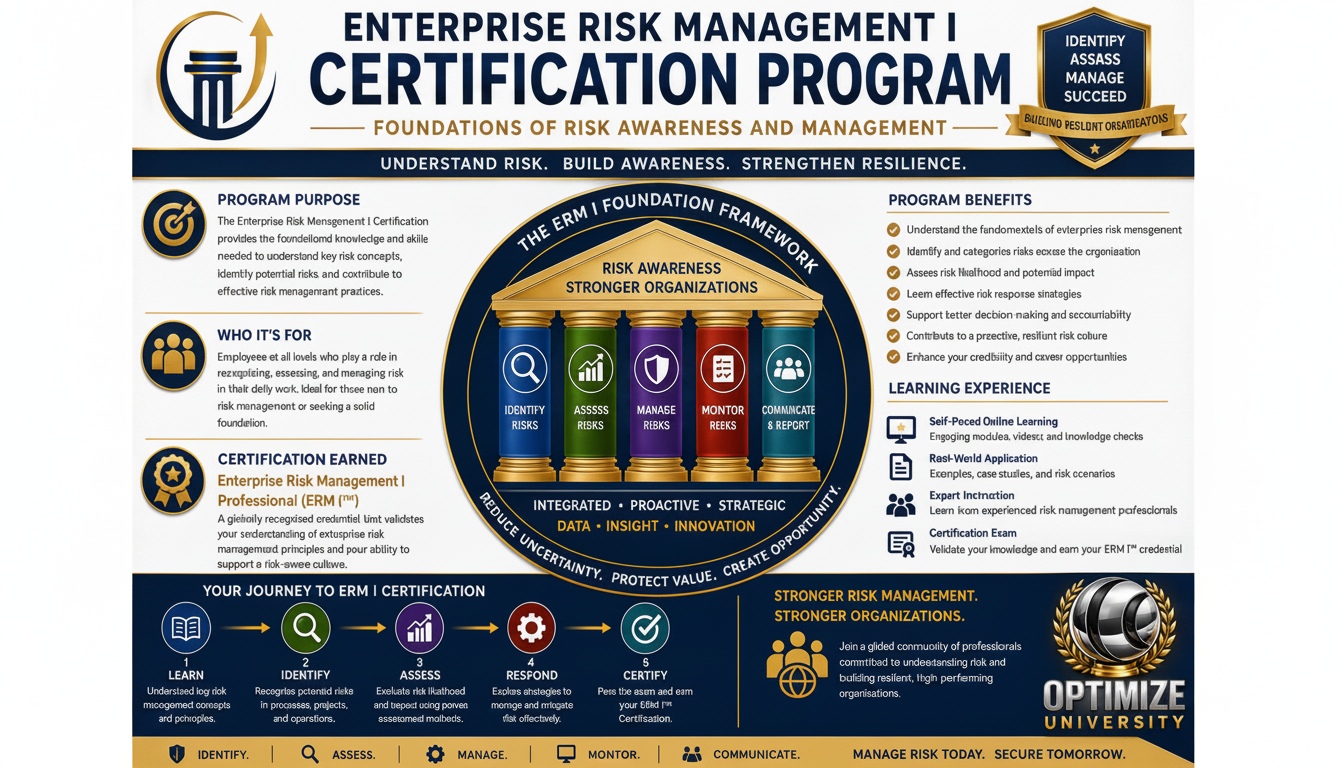
The ERM I Structure Methodology
The course introduces participants to a disciplined process for establishing the foundation of Enterprise Risk Management:
1. Understand the OrganizationClarify the organization's mission, vision, strategy, objectives, operating environment, stakeholders, and critical dependencies.
2. Establish ERM GovernanceDetermine how risk management will be governed and how leadership oversight will be established.
3. Define Roles and ResponsibilitiesEstablish accountability for risk ownership, assessment, mitigation, monitoring, reporting, and escalation.
4. Establish the ERM FrameworkDevelop the policies, processes, terminology, categories, criteria, and management structure required to support consistent enterprise risk management.
5. Define Risk Appetite and ToleranceEstablish parameters that help leaders and risk owners understand acceptable levels of organizational risk.
6. Establish Risk Identification MethodsDetermine how risks will be identified across functions, programs, processes, projects, and strategic initiatives.
7. Establish Assessment and Prioritization CriteriaDevelop a consistent methodology for evaluating and comparing enterprise risks.
8. Establish Risk Response RequirementsDefine how risks will be accepted, avoided, transferred, reduced, mitigated, escalated, or otherwise addressed.
9. Establish Monitoring and ReportingDetermine how leadership will receive meaningful information regarding enterprise risk exposure and mitigation performance.
10. Establish Continuous ReviewCreate mechanisms for periodically evaluating whether the ERM program and individual risk responses remain effective.
From Theory to Application
A defining characteristic of Enterprise Risk Management I is its emphasis on learning by doing. This is not simply an introductory lecture on risk-management terminology. Each major step of the ERM structure-development process includes a corresponding practical exercise. Participants progressively apply what they learn to the development of an ERM framework so that concepts introduced during instruction are immediately connected to organizational application. The progression becomes: Learn → Apply → Build → Evaluate → Improve
By the conclusion of the course, participants should understand both what an ERM program requires and how the individual components fit together.
Building the Enterprise Risk Management Plan
A central outcome of ERM I is preparing participants to develop the foundational components of an Enterprise Risk Management Plan. Depending upon the organization, these components may include:
* ERM purpose and objectives
* Organizational context
* ERM governance structure
* Leadership oversight
* Risk-management roles and responsibilities
* Risk ownership
* Risk categories and taxonomy
* Risk appetite and tolerance considerations
* Risk identification methodology
* Risk assessment criteria
* Likelihood and impact methodology
* Risk prioritization approach
* Risk response requirements
* Mitigation planning structure
* Escalation requirements
* Risk monitoring expectations
* Reporting requirements
* Performance indicators
* Review cycles
* Continuous improvement requirements
The goal is to provide participants with more than theoretical knowledge. They begin building the organizational infrastructure required to manage enterprise risk effectively.
Who Should Enroll?
Enterprise Risk Management I is designed for professionals who have responsibility for organizational performance, decision-making, operations, programs, governance, compliance, or risk, including: executives and senior leaders, managers and supervisors, enterprise risk professionals, program and project managers, operations professionals, strategy professionals, compliance professionals, internal audit professionals, financial professionals, cybersecurity and technology professionals, supply-chain and procurement professionals, business continuity professionals, organizational optimization professionals, government and military leaders, business owners and entrepreneurs, professionals preparing for advanced Enterprise Risk Management certification.
No advanced ERM background should be required. The course establishes the foundation necessary for participants to progress into the more technical and deployment-focused components of the certification series.
Certification Outcomes
Upon successful completion of Enterprise Risk Management I, participants should be better prepared to:
* Explain the purpose and value of Enterprise Risk Management.
* Understand the relationship between organizational objectives and enterprise risk.
* Recognize major categories of organizational risk.
* Establish the foundational structure of an ERM program.
* Define ERM governance, ownership, accountability, and oversight requirements.
* Understand risk appetite and risk tolerance concepts.
* Develop consistent approaches for identifying organizational risks.
* Understand basic methods for evaluating likelihood, impact, and risk significance.
* Prioritize risks according to their potential effect on organizational objectives.
* Understand fundamental risk-response and mitigation strategies.
* Establish monitoring, reporting, and escalation expectations.
* Integrate ERM considerations into organizational leadership and decision-making.
* Prepare for the technical risk-management activities introduced in Enterprise Risk Management II.
Organizational Benefits
Organizations that develop employees in ERM fundamentals establish a stronger foundation for managing uncertainty across the enterprise. Rather than allowing individual functions to manage risk independently, an ERM structure creates a common language, methodology, governance model, and decision framework.
This can help organizations:
* Improve visibility of enterprise risks.
* Strengthen executive and Board-level risk awareness.
* Create clearer risk ownership and accountability.
* Improve consistency in risk assessment.
* Better prioritize mitigation resources.
* Improve communication of significant risks.
* Reduce fragmented and reactive risk management.
* Strengthen strategic decision-making.
* Connect risk management with organizational objectives.
* Identify emerging risks earlier.
* Improve organizational resilience.
* Support stronger organizational optimization and continuous improvement.
Most importantly, a structured ERM program helps leadership move from reacting to problems after they occur toward anticipating and managing uncertainty before it prevents organizational success.
Creating a Risk-Aware Organization
Enterprise Risk Management is not solely the responsibility of a risk department. Effective ERM requires leaders, managers, employees, and risk owners throughout the organization to understand how their decisions and activities can create, increase, reduce, or manage organizational risk.
A mature risk-aware organization encourages people to ask:
* What are we trying to accomplish?
* What could prevent us from achieving it?
* What could change the outcome?
* How significant is the risk?
* Who owns the risk?
* What should we do about it?
* How will we know whether our response is working?
These questions establish the mindset required for effective Enterprise Risk Management.
The First Step Toward Enterprise Risk Management Certification
Enterprise Risk Management I establishes the structure. It creates the foundation upon which the more advanced capabilities of the ERM certification pathway are built.
The three-part progression moves participants from understanding the organizational structure of ERM to applying technical risk-management methodologies and ultimately deploying and sustaining an enterprise-wide risk-management capability:
* ERM I — StructureBuild the ERM foundation.
* ERM II — Technical ApplicationIdentify, assess, prioritize, analyze, and develop responses to enterprise risks.
* ERM III — DeploymentImplement, integrate, monitor, govern, and continuously improve the ERM program across the organization.
Together, the three certifications develop professionals who can move from understanding enterprise risk to building and operating an effective Enterprise Risk Management program.
Enterprise Risk Management I (Structure) - Understand the Organization. Establish the Structure. Define Accountability. Build the Framework. Prepare to Manage Risk. Effective Enterprise Risk Management Begins with Structure.
Optimize • Achieve • Excel
Meet the Instructor
Steven Bradt