
Change Management for Employees
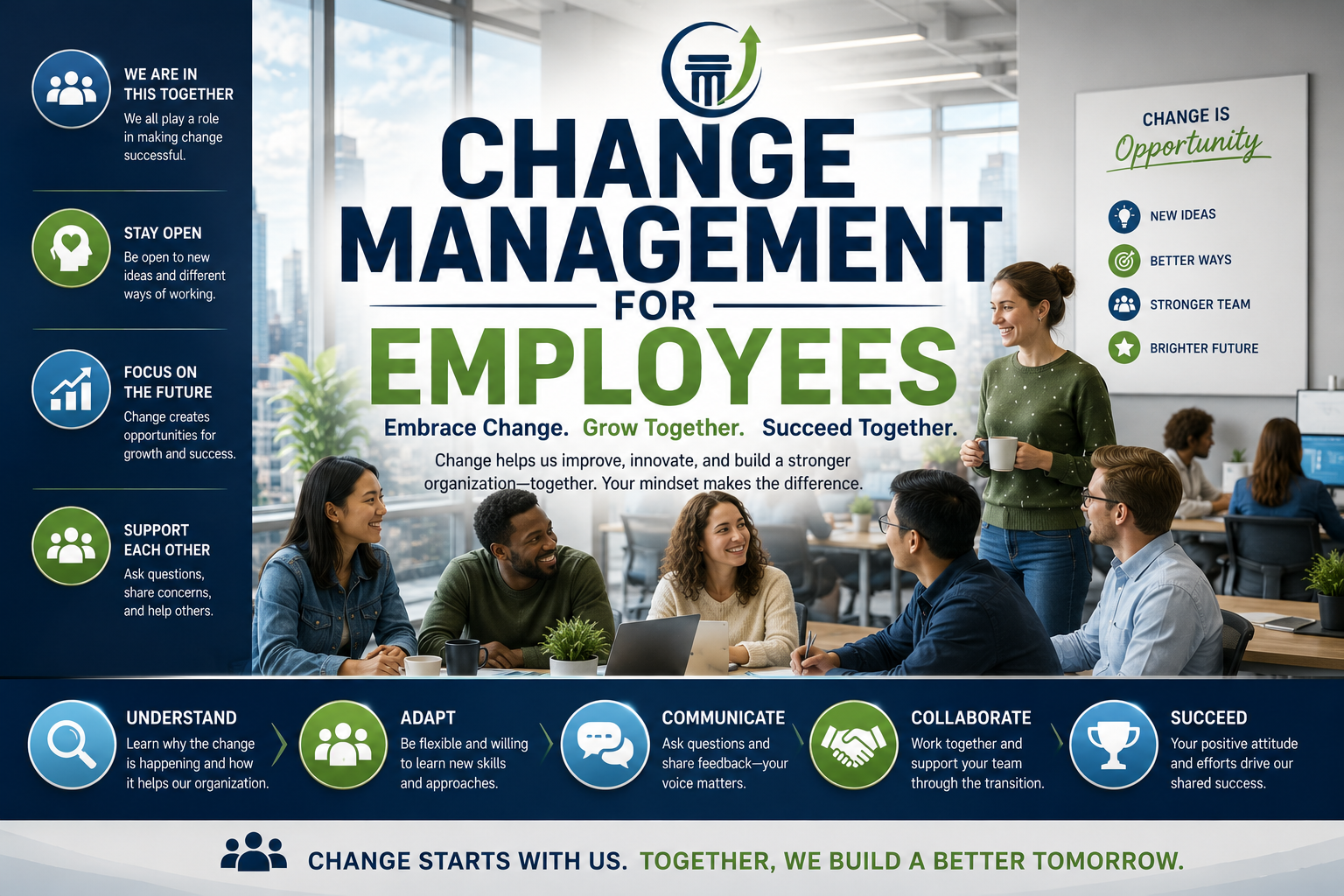
Understand the Change. Embrace Your Role. Help Make Change Successful.
The Change Management for Employees (CME) Certification Program is a practical professional development program designed to provide employees at all organizational levels with the knowledge, skills, tools, and mindset necessary to understand, navigate, support, and positively influence organizational change. Leadership has no organizational boundaries. Every employee encounters opportunities to lead—through their attitude, communication, collaboration, problem-solving, adaptability, and willingness to help others successfully navigate change. Employees are not simply the recipients of organizational change. They are essential participants in determining whether change succeeds. The CME program provides participants with a foundational understanding of how organizational change occurs, why people respond differently to change, what factors contribute to successful transformation, and how employees can positively contribute throughout the change journey. Participants learn practical approaches for understanding the purpose of change, navigating uncertainty, communicating effectively, recognizing their own reactions, supporting colleagues, developing new competencies, identifying barriers, providing constructive feedback, and helping the organization transition successfully from its current state to its desired state.
The objective is straightforward:
* Understand the Change.
* Prepare for the Change.
* Participate in the Change.
* Support the Change.
* Help Sustain the Change.
Why Take Change Management for Employees?
Change is a constant part of today's organizational environment.Organizations introduce new technologies. Processes are redesigned. Responsibilities change. Strategies evolve. Leadership changes. Organizations restructure. Artificial intelligence transforms how work is performed. New customer expectations emerge. Regulations change. Organizations merge, grow, downsize, modernize, and continuously improve. Every one of these changes ultimately affects people. While leadership may establish the direction and sponsors may approve the transformation, employees are frequently the people who must turn the change into reality. A new system creates little value if employees do not use it. A redesigned process produces limited improvement if employees continue using the old process. A new strategy cannot succeed if employees do not understand how their responsibilities support it. For this reason, successful organizational change requires more than executive sponsorship and project management. It requires employee understanding, participation, capability, adoption, and commitment. The Change Management for Employees Certification Program helps employees understand their role in making that happen.
Every Employee Has a Role in Change
Employees may not always have the authority to decide what organizational changes will occur, but they have significant influence over how successfully those changes are implemented. Employees influence change through the questions they ask, information they share, behaviors they demonstrate, feedback they provide, problems they identify, solutions they recommend, and support they provide to others. The program helps participants understand the change journey: Current State → Awareness → Understanding → Transition → Learning → Adoption → Desired State → Sustained Performance Employees learn that change is not simply an event announced by leadership. It is a transition that requires people to move from familiar ways of working toward new expectations, behaviors, processes, technologies, responsibilities, or organizational conditions.
Understanding the People Side of Change
Organizations can design excellent technical solutions and still struggle with implementation because the people side of change has not been adequately addressed. Employees may experience uncertainty about:
* Why is this change happening?
* How will it affect me?
* What will I be expected to do differently?
* Will I be able to succeed in the new environment?
* What skills will I need?What happens to my current responsibilities?
* Where can I get help?
* Will leadership listen to employee concerns?
* These are legitimate questions during organizational transformation.
CME helps employees understand these reactions and provides practical techniques for navigating change constructively.
What You Will Learn
Throughout the Change Management for Employees Certification Program, participants develop foundational knowledge and practical capabilities for successfully participating in organizational change.
Understanding Organizational Change
Learn why organizations change and how internal and external forces can create the need for transformation. Participants examine strategic, operational, technological, workforce, customer, financial, regulatory, competitive, and organizational factors that frequently drive change.
Understanding Why Change Succeeds or Fails
Explore the critical success factors that influence organizational change. Participants learn why leadership commitment, communication, employee engagement, clear objectives, training, resources, accountability, feedback, and reinforcement are essential to successful transformation.
Understanding Your Role in Change
Learn how individual employees contribute to the success or failure of organizational transformation. Participants examine how personal behaviors, communication, adaptability, collaboration, accountability, and willingness to learn influence both individual and organizational outcomes.
Understanding the Change Curve
Participants are introduced to the change curve as a practical framework for understanding how people may respond emotionally and behaviorally to significant change. Employees learn that people may move through change differently and at different speeds. Understanding these reactions can help employees better manage their own transition while showing greater awareness when working with colleagues experiencing the same change differently.
Change Competencies
Develop competencies that can strengthen individual effectiveness during organizational change, including:
* Adaptability
* Communication
* Collaboration
* Resilience
* Problem-solving
* Continuous learning
* Accountability
* Constructive feedback
* Emotional awareness
* FlexibilityInitiative
* Change readiness
These capabilities are increasingly important in organizations that must continuously adapt.
Communicating During Change
Learn the importance of asking questions, seeking accurate information, avoiding rumors and misinformation, communicating concerns constructively, and sharing information appropriately. Employees also learn the importance of understanding the difference between productive questions and unproductive resistance. Managing UncertaintyChange often creates uncertainty because employees may not immediately know what the future environment will look like. Participants learn practical techniques for focusing on what is known, identifying what information is needed, understanding what they can influence, and preparing for new expectations.
Understanding Resistance
Resistance to change can occur for many reasons, including uncertainty, loss of familiarity, lack of information, previous negative experiences, workload concerns, fear of failure, or disagreement with the proposed direction. Participants learn how to recognize resistance in themselves and others and how to respond constructively.
Learning New Ways of Working
Successful change frequently requires employees to develop new knowledge, skills, behaviors, processes, or technology capabilities. Participants learn the importance of approaching change with a learning mindset and actively seeking the training, resources, coaching, and support necessary for successful adoption. Providing Constructive FeedbackEmployees often see implementation challenges before leadership does. CME emphasizes the importance of communicating observations, risks, barriers, improvement opportunities, and lessons learned through appropriate channels. Employee feedback can become an important source of information for improving change implementation.
Supporting Others Through Change
Employees influence one another. Participants learn how collaboration, encouragement, knowledge sharing, peer support, and constructive attitudes can help teams navigate organizational transition more effectively.
Sustaining Change
Change is not complete when a new process, technology, structure, or policy is launched.It must become part of normal organizational behavior. Participants learn how individual accountability, reinforcement, performance expectations, continuous learning, and Continuous Process Improvement help sustain organizational change.
The Change Management for Employees Approach
The CME program provides employees with a straightforward framework for navigating organizational change:
1. Understand Why the Change Is NecessaryLearn what organizational challenge, opportunity, risk, or strategic objective is driving the change.
2. Understand What Is ChangingIdentify how the change may affect responsibilities, processes, technology, relationships, behaviors, or performance expectations.
3. Understand Your ReactionRecognize personal concerns, assumptions, questions, and reactions to the change.
4. Seek UnderstandingAsk appropriate questions, obtain accurate information, and understand what successful implementation requires.
5. Prepare YourselfIdentify the knowledge, skills, tools, training, and support needed to succeed.
6. Participate ConstructivelyEngage in training, implementation activities, testing, problem-solving, feedback, and improvement efforts.
7. Support the TeamShare information, collaborate, help colleagues, and contribute positively to the transition.
8. Adopt the ChangeApply new processes, behaviors, technologies, responsibilities, and expectations consistently.
9. Identify Improvement OpportunitiesCommunicate barriers, risks, lessons learned, and opportunities to improve implementation.
10. Help Sustain the ChangeReinforce new practices and contribute to Continuous Process Improvement.
From Change Recipient to Change Participant
One of the most important concepts in CME is the transition from viewing employees as recipients of change to recognizing them as participants in change. A recipient asks: “What is happening to me?”, An engaged participant also asks:“Why is this happening?”, “What does success look like?”, “What do I need to learn?”, “What can I influence?”, “How can I contribute?”, “What problems should I communicate?”, “How can I help my team succeed?” This shift in perspective can significantly improve employee ownership and organizational change readiness.
From the Classroom Into the Workplace
The Change Management for Employees Certification Program emphasizes practical application. Participants use realistic organizational change scenarios and exercises to examine their own responses, evaluate change impacts, identify potential barriers, practice constructive communication, and develop approaches for supporting successful implementation. The learning progression becomes: Understand → Prepare → Engage → Learn → Adapt → Support → Adopt → Improve → Sustain The objective is to give employees tools they can immediately apply whenever organizational change occurs.
Developing a Personal Change Action Plan
A practical outcome of the CME program is the development of a Personal Change Action Plan. Depending upon the change initiative, participants may identify:
* Why the change is occurring
* Organizational objectives associated with the change
* How the change affects their responsibilities
* Personal questions or concerns
* Knowledge and skill requirements
* Training needs
* Resources and support requirements
* Key stakeholders
* Communication requirements
* Potential barriers
* Actions within their control
* Opportunities to support colleagues
* Feedback and improvement opportunities
* Personal adoption objectives
* Measures of successful transition
* Continuous improvement opportunities
The Personal Change Action Plan helps participants translate change-management concepts into individual action and accountability.
Who Should Enroll?
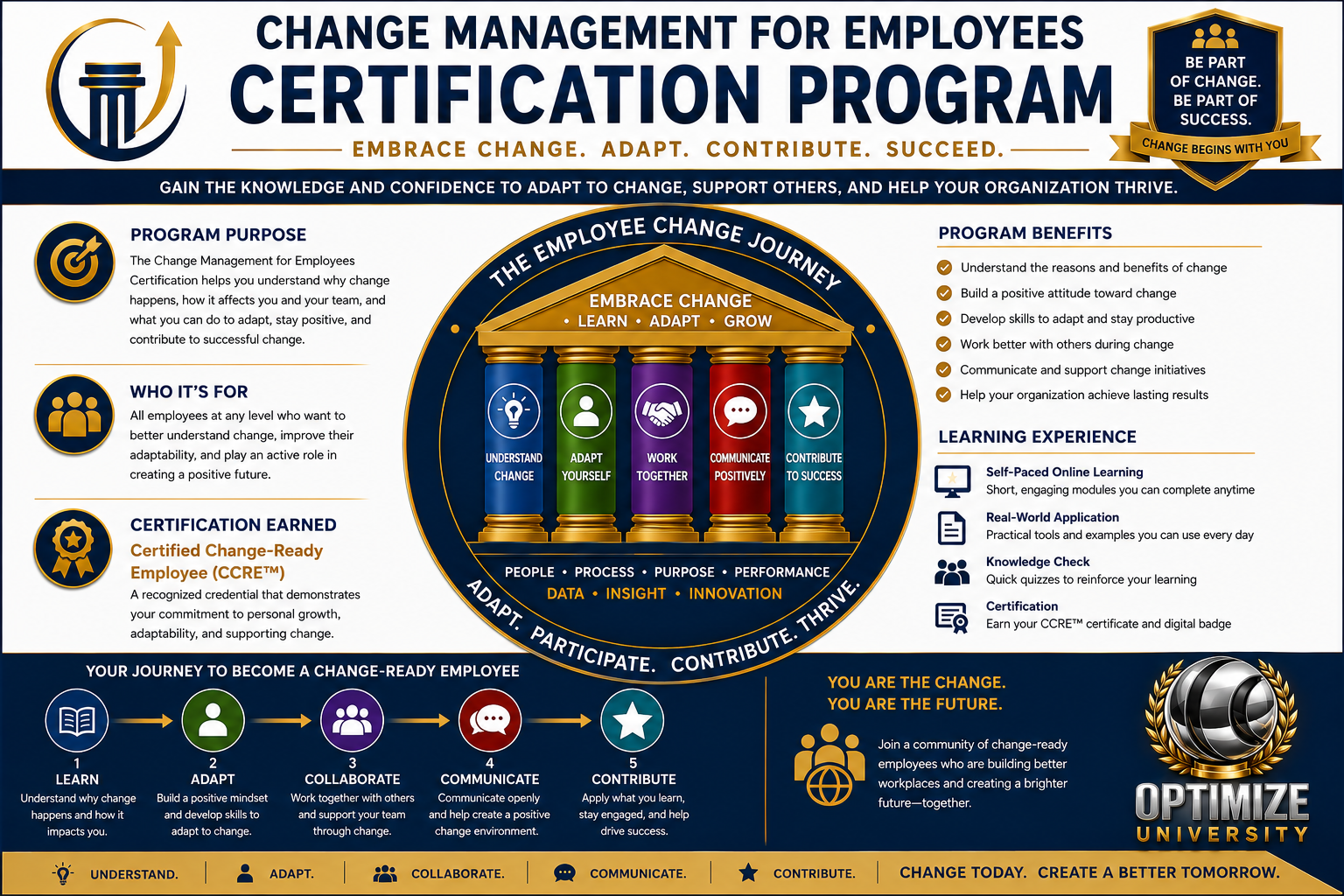
The Change Management for Employees Certification Program is designed to provide a common change-management foundation throughout the workforce and is appropriate for: employees at all organizational levels, frontline employees, administrative and support personnel, technical professionals, operations personnel, project and program team members, cross-functional teams, new employees, emerging leaders, supervisors, employees participating in transformation initiatives, employees affected by technology implementations, employees participating in organizational optimization initiatives, contractors and organizational partners, where appropriate, and professionals preparing for greater leadership responsibilities. Because change affects the entire organization, CME can also serve as an effective enterprise-wide training program before significant organizational transformation initiatives are launched.
Certification Outcomes
Upon successful completion of the Change Management for Employees Certification Program, participants should be better prepared to:
* Explain why organizations change and why employee adoption matters.
* Understand the fundamental principles of organizational change.
* Recognize common factors that contribute to successful or unsuccessful change.
* Understand their individual role in organizational transformation.
* Use the change curve to better understand reactions to change.
* Recognize personal and organizational resistance.
* Communicate questions and concerns constructively.
* Identify the knowledge and skills necessary to succeed in a changing environment.
* Participate effectively in organizational change initiatives.
* Adapt to new processes, technologies, responsibilities, and expectations.
* Provide meaningful feedback regarding implementation challenges.
* Support colleagues and teams through organizational transition.
* Demonstrate accountability for personal adoption.
* Identify opportunities to improve change implementation.
* Contribute to sustaining organizational change.
* Develop competencies that improve long-term change readiness.
Organizational Benefits
Organizations that provide employees with foundational change-management training create a workforce better prepared to participate constructively in transformation. Employee change-management capability can help organizations:
* Improve understanding of why change is necessary.
* Reduce uncertainty and misinformation.
* Strengthen communication between employees and leadership.
* Improve employee engagement.
* Identify resistance and barriers earlier.
* Improve participation in training and implementation activities.
* Accelerate adoption of new processes and technologies.
* Strengthen cross-functional collaboration.
* Improve employee feedback during implementation.
* Reduce disruption associated with organizational transition.
* Improve accountability for adoption.
* Strengthen Continuous Process Improvement.
* Support Organizational Optimization.
* Increase organizational adaptability and resilience.
Most importantly, the program helps employees understand that they have an important role in determining whether organizational change becomes a temporary initiative or a sustainable improvement.
Creating a Change-Ready Workforce
Organizations cannot predict every change they will encounter. They can, however, develop people who are better prepared to respond to change. A change-ready workforce learns to ask:
* Why is this change necessary?
* What is expected of me?
* What do I need to learn?
* What can I influence?
* What questions should I ask?
* What barriers should I communicate?
* How can I help my team?
* How will we know the change is working?
* What can we improve?
When employees develop this mindset, organizational adaptability becomes more than a leadership capability. It becomes a workforce capability.
Change Management and the Journey to Optimization
Change Management is an essential component of Organizational Optimization because every meaningful improvement requires some degree of change. Assessments identify opportunities. Leaders establish direction. Alignment determines priorities. Architects design improvements. Change Management helps people transition. Employees make the transformation real through adoption. The relationship becomes: ASSESS → IDENTIFY → DESIGN → COMMUNICATE → ENGAGE → CHANGE → ADOPT → OPTIMIZE → SUSTAIN
The Change Management for Employees Certification Program helps ensure employees understand their role throughout this journey.
Leadership Has No Boundaries
Leadership is not defined exclusively by position, title, or organizational authority. Employees demonstrate leadership whenever they:
* Help a colleague understand a new process.Identify a problem before it becomes larger.
* Offer a constructive solution.
* Ask an important question.
* Learn a new skill.
* Adapt to a new technology.
* Communicate accurate information.
* Provide meaningful feedback.
* Support a team through uncertainty.
* Demonstrate the behaviors necessary for successful change.
These everyday actions can significantly influence organizational transformation. The Change Management for Employees Certification Program develops the understanding that everyone has opportunities to lead, learn, adapt, and support change.
From Experiencing Change to Helping Make Change Successful
Successful organizational transformation requires leadership from the top—but it also requires participation throughout the organization.
The Change Management for Employees Certification Program prepares employees to understand change, navigate transition, develop the competencies required for the future, support their colleagues, provide constructive feedback, adopt new ways of working, and help sustain organizational improvements. Employees are not simply affected by organizational change. They help determine whether it succeeds.
Change Management for Employees (CME). Understand the Change. Prepare Yourself. Engage in the Process. Learn and Adapt. Support the Team. Adopt the Change. Help Sustain the Improvement.
Change succeeds when leadership provides direction and employees turn that direction into action.
Optimize • Achieve • Excel
Meet the Instructor
Robert Hutcherson PhD